
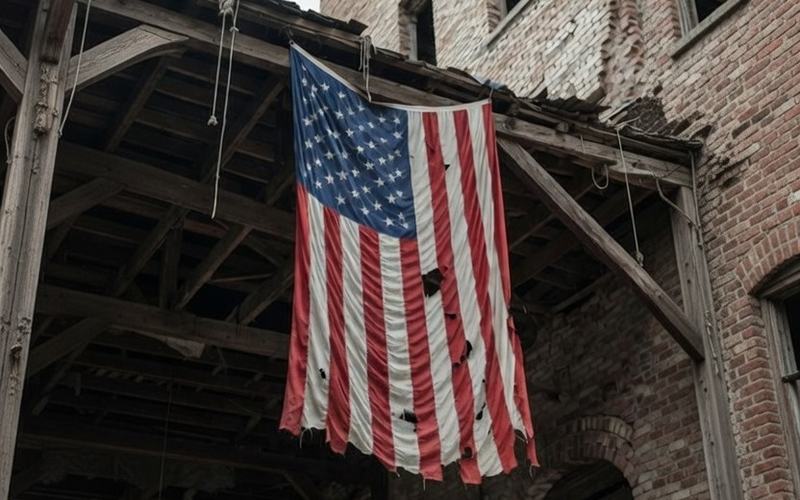
A new Gallup poll delivers some sobering news: American optimism about the future has slumped to a record low. Just 59.2% of U.S. adults now anticipate a high-quality life in five years—the lowest level since Gallup began tracking this measure nearly two decades ago (interestingly, Hispanic respondents declined the least in optimism over the past 3 years, and Black respondents are the most optimistic of the surveyed subgroups). That’s a 9.1-point drop since 2020, translating to roughly 24.5 million fewer optimistic Americans. The share rating both their current and future lives as “thriving” has fallen to 48%, with the steepest declines hitting certain demographic and partisan groups amid lingering inflation scars, pandemic aftershocks, and shifting political winds.
This isn’t just another headline about national mood. It’s a warning light flashing on the dashboard of American life.
In a recent piece for Real Truth Media, I examined the accelerating erosion of the post-World War II rules-based international order—the system of alliances, institutions, and norms that underwrote decades of relative stability, prosperity, and American leadership. That order is fraying under the weight of great-power competition, institutional fatigue, and domestic distractions. What the Gallup data reveals is the domestic mirror image of that global unraveling: a growing sense among ordinary Americans that the future may not be better than the present.
When people lose confidence that tomorrow will be brighter, it rarely stems from a single cause. It’s the cumulative effect of visible failures at home compounded by a sense that the world stage is shifting in ways that no longer favor us. Endless domestic spending without results feeds that pessimism. So does the perception that the international system America built and defended is no longer delivering the security and opportunity it once did.
This disconnect erodes optimism at its roots. Parents see their tax dollars funding systems that too often fail to–for instance–prepare children for a competitive world, while politicians and unions demand still more resources with little accountability. When families feel trapped in underperforming schools because of zip code or bureaucracy, it’s natural for broader hope to dim. The Gallup optimism slide tracks closely with these frustrations: people sense that core institutions meant to deliver upward mobility—including education—are no longer reliable engines of progress.
My recent Real Truth Media article argued that the rules-based international order is cracking not from external shock alone, but from internal neglect and overreach. Alliances strain under uneven burden-sharing. Institutions designed for a different era struggle with great-power rivalry and transnational challenges.
When the global order that amplified American prosperity begins to fray, the effects are felt at kitchen tables: higher costs for goods, energy insecurity, questions about future job markets, and a vague but persistent sense that the world is becoming less predictable and less favorable to the next generation. Optimism thrives when people believe the system—both domestic and international—is fair, functional, and oriented toward opportunity. Today, too many Americans see neither. And, to be perfectly honest, I don’t blame them. I actually do think there’s plenty to be optimistic about, but not when I look at the dilapidated global order.
The Gallup findings cut across demographics, though declines have been sharper among certain groups in recent years. This isn’t a partisan mirage; it’s a broad erosion of confidence that transcends typical political cycles. When even the promise of a better future feels uncertain, people pull back—from risk-taking, from long-term planning, from faith in institutions.
Reversing this slide won’t come from more spending alone or nostalgic appeals to past dominance. It requires honest reckoning in two arenas.
At home, we must confront the inefficiencies and fraud that plague our government at every level. Abroad, America must approach the evolving international order with clear-eyed realism rather than denial. Who knows? We may even begin to fulfill Washington’s vision of an America that is selective in its engagement in alliances, and renews its focus on domestic industrial and technological strength. When Americans see their country acting with purpose and strength on the world stage—while fixing broken systems at home—optimism has a chance to rebound.
The Gallup poll is not merely a snapshot of national mood. It is a symptom of deeper structural challenges: domestic institutions that consume ever more resources with diminishing returns, and a global order in transition that no longer automatically magnifies American advantage.
Optimism is not blind faith. It is the reasonable expectation that effort and ingenuity will be rewarded. Restoring that expectation starts with honest assessment and courageous reform.
Matthew Nielsen is Board President at the Educational Freedom Institute and author of Critical Condition: Destructive Ideologies in America’s Classrooms. His recent piece on the rules-based international order appeared at Real Truth Media.
Comments
No comments yet. Be the first to share your thoughts.