
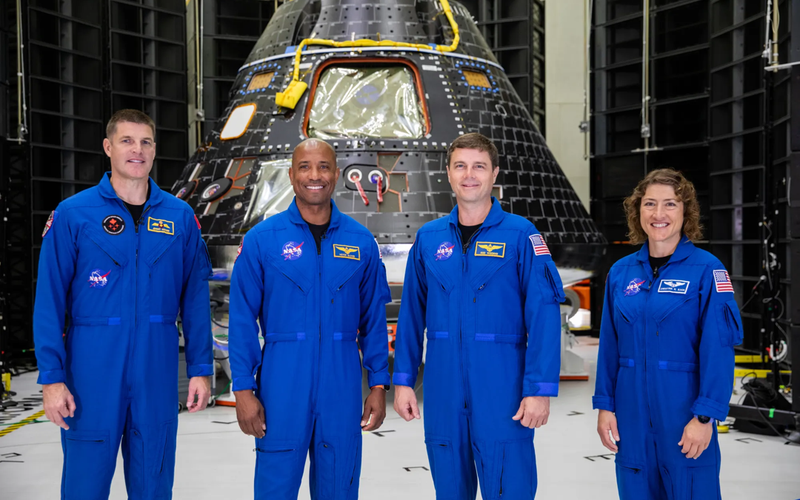
NASA’s Artemis II mission has begun its four-day journey back to Earth following a historic crewed flight around the moon, marking the agency’s first human return to deep space beyond low Earth orbit since the Apollo era.
The spacecraft is scheduled to splash down in the Pacific Ocean on Friday after completing a mission that exceeded Apollo 13’s distance record of 248,655 miles, reaching a maximum distance of 252,756 miles from Earth.
During the lunar flyby, the crew passed behind the moon, triggering a roughly 40-minute communications blackout as they reached their closest approach of 4,067 miles above the surface. Astronauts described the दृश्य as striking, with bright lunar peaks and expansive views visible even without specialized equipment.
Canadian astronaut Jeremy Hansen said the view from near the moon was “unbelievable,” encouraging future generations to surpass the mission’s achievements. Pilot Victor Glover noted that some illuminated peaks appeared almost snow-covered, while the crew documented the journey using both professional cameras and personal devices.
As the spacecraft circled the moon, astronauts also received a recorded message from Apollo 13 commander Jim Lovell, who welcomed them to what he called his “old neighborhood” in a recording made shortly before his death. Lovell previously flew on Apollo 8, the first mission to orbit the moon.
Artemis II represents NASA’s first astronaut mission to the moon since Apollo 17 in 1972 and serves as a key step in the agency’s broader lunar exploration program. The mission is intended to pave the way for Artemis III, which is expected to involve further testing in preparation for a future crewed lunar landing.
NASA plans for a subsequent mission to land astronauts near the moon’s south pole later in the decade, part of a long-term effort to establish a sustained human presence on and around the lunar surface.
Crew members also reflected on the broader significance of the mission, emphasizing the perspective gained from viewing Earth from deep space. Glover described the planet as a singular, shared environment within a vast universe, underscoring the importance of unity as humanity expands its reach beyond Earth.

Comments
No comments yet. Be the first to share your thoughts.