
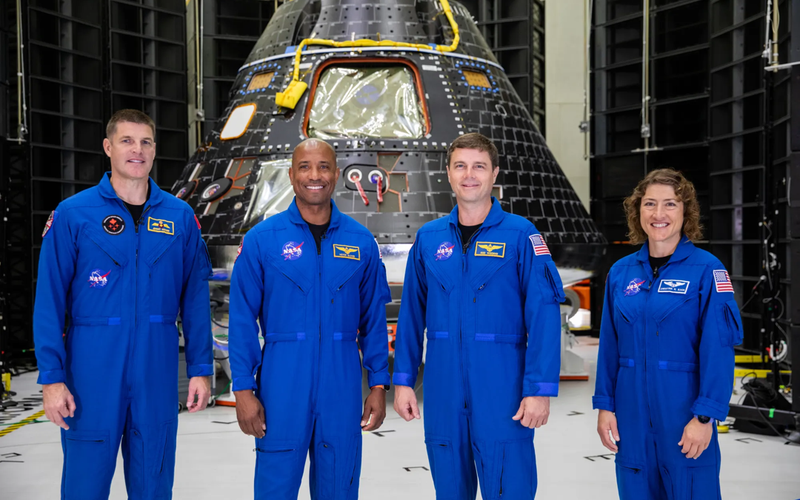
NASA's Artemis II mission marked a major milestone Thursday when the four-astronaut crew entered a stable high Earth orbit following a successful launch from Kennedy Space Center.
The Space Launch System rocket lifted off at 6:35 p.m. EDT on Wednesday, April 1, carrying Commander Reid Wiseman, Pilot Victor Glover, Mission Specialist Christina Koch and Canadian Space Agency astronaut Mission Specialist Jeremy Hansen aboard the Orion spacecraft named Integrity. This flight represents the first crewed Artemis mission and the first human journey toward the Moon since Apollo 17 in 1972.
After separating from the rocket stages, Orion achieved initial orbit. The crew awakened early Thursday to the song "Sleepyhead" by Young and Sick and monitored the 43-second perigee raise burn of the service module's main engine. This maneuver raised the spacecraft's lowest orbital point, ensuring stability for upcoming operations. Flight controllers confirmed all systems performed nominally, with the crew resting in shifts afterward.
Next, the mission team anticipates the translunar injection burn at 7:49 p.m. EDT Thursday. This five-minute, 49-second firing will provide the velocity change needed to propel Orion out of Earth orbit toward the Moon. Approval awaits the mission management team's review of spacecraft performance.
The 10-day mission follows a free-return trajectory, slingshotting around the Moon without entering lunar orbit or landing. The crew expects to reach lunar vicinity around April 6 for a close flyby, approaching within about 80 kilometers of the surface. They will view the far side of the Moon, testing Orion's deep-space systems, life support, and communications for future missions.
Artemis II builds on the uncrewed Artemis I flight in 2022, validating technologies for NASA's goal of sustainable lunar presence. Artemis III aims for the first crewed landing near the lunar south pole as early as 2027. The diverse crew includes the first woman, first person of color, and first non-American on a lunar mission.
Ground teams resolved minor issues like toilet troubleshooting and conducted proximity operations. Live views from Orion cameras stream as bandwidth allows, with trackers available on NASA's website showing the spacecraft's position roughly 42,500 miles from Earth Thursday afternoon.
The mission underscores U.S. leadership in space exploration, partnering with international allies while advancing capabilities for Mars.

Comments
No comments yet. Be the first to share your thoughts.