
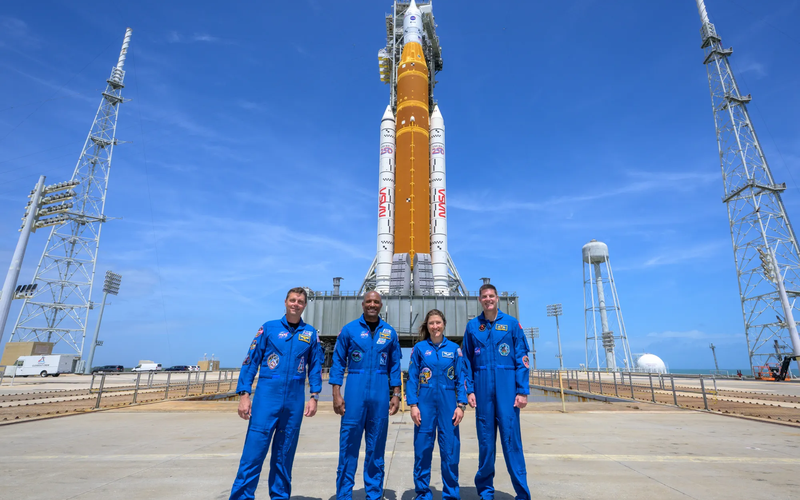
NASA's Artemis II crew marked a significant milestone Saturday, passing the halfway point to the Moon as their Orion spacecraft hurtles toward a historic lunar flyby.
The four astronauts, Commander Reid Wiseman, Pilot Victor Glover, Mission Specialist Christina Koch, and Canadian Space Agency astronaut Jeremy Hansen, launched atop the agency's Space Launch System rocket from Kennedy Space Center in Florida on Wednesday, April 1. This marks the first time humans have ventured beyond low Earth orbit since Apollo 17 in 1972.
After completing a translunar injection burn on Thursday, April 2, Orion departed Earth's gravitational influence and settled onto its precise free-return trajectory. Flight controllers canceled a planned outbound trajectory correction burn, deeming the path accurate enough. As of late Saturday, the spacecraft was more than 160,000 miles from Earth and less than 120,000 miles from the Moon, closer to its destination than to home.
The crew has conducted spacecraft inspections, tested systems, and prepared for upcoming lunar observations. They reported a brief burning smell from the Orion toilet late Friday, likened to an old heater, but mission control cleared continued use after evaluation. Separately, a urine vent blockage was resolved Saturday using heaters and solar positioning, restoring normal wastewater operations.
No major issues have arisen during the outbound leg. NASA held a news conference Friday at Johnson Space Center in Houston to update on progress, with daily briefings continuing through splashdown.
Artemis II is a 10-day test flight designed to validate Orion's life support, propulsion, and communications in deep space. The crew will not enter lunar orbit or land but will loop around the Moon's far side starting Monday, April 6, coming within several hundred miles. Astronauts plan to photograph the surface, including shadowed craters, and conduct scientific observations to inform future missions.
After the flyby, Orion will sling back toward Earth using the Moon's gravity, with reentry and splashdown targeted for April 10 off San Diego. The mission paves the way for Artemis III, slated for lunar landing in 2027.
NASA released stunning images from the crew, capturing a crescent Earth against the void. The astronauts have shared their first words from space, expressing excitement about the views and the significance of their journey.
This success underscores NASA's return to human lunar exploration under the Artemis program, aimed at sustainable presence on the Moon and preparation for Mars.

Comments
No comments yet. Be the first to share your thoughts.