
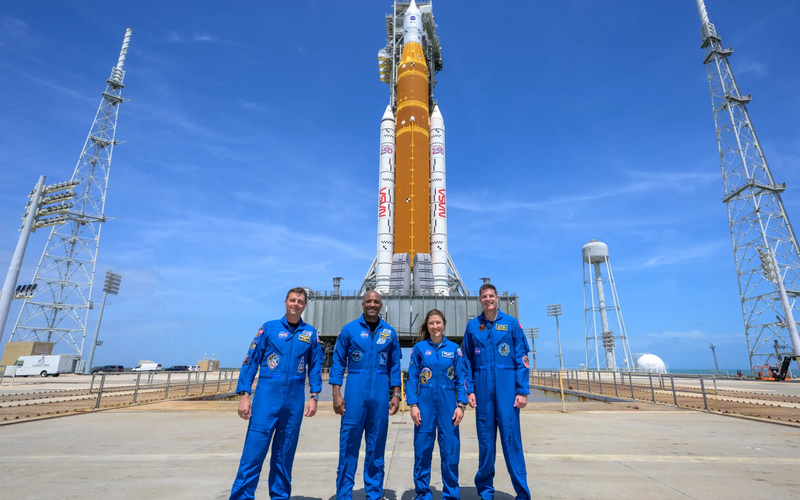
NASA’s Space Launch System rocket roared to life and launched from Kennedy Space Center, carrying the Artemis II crew into space and officially beginning a new era of lunar exploration.
The mission marks the first time astronauts have traveled toward the moon since the Apollo program ended in 1972. On board are NASA astronauts Reid Wiseman, Victor Glover, and Christina Koch, along with Canadian astronaut Jeremy Hansen. Several crew members bring prior spaceflight experience, including missions aboard the International Space Station.
The crew will travel thousands of miles beyond the moon, perform a flyby, and return to Earth in a mission expected to last less than 10 days. The flight will follow a “free-return trajectory,” using the gravity of the moon and Earth to guide the spacecraft around the lunar surface and safely back home with minimal fuel use.
Unlike the Apollo era, Artemis II represents a more diverse step forward for space exploration, with the first woman, first Black astronaut, and first non-American assigned to a lunar mission.
NASA officials say the mission is a key milestone in plans to establish a long-term human presence on the moon, including a targeted landing near the lunar south pole later this decade. The Artemis program is also seen as a stepping stone for eventual crewed missions to Mars.
The Orion spacecraft and its systems, including newly designed launch and reentry suits, will be tested throughout the flight to ensure astronaut safety on future deep-space missions.
The mission will conclude with a splashdown in the Pacific Ocean, where U.S. Navy recovery teams will retrieve the crew after reentry.
With the successful launch, NASA has taken a major step toward reestablishing human exploration beyond low-Earth orbit and returning Americans and their international partners to deep space.
Like the Apollo missions, the crew is expected to return with a splashdown in the Pacific Ocean.

Comments
No comments yet. Be the first to share your thoughts.