
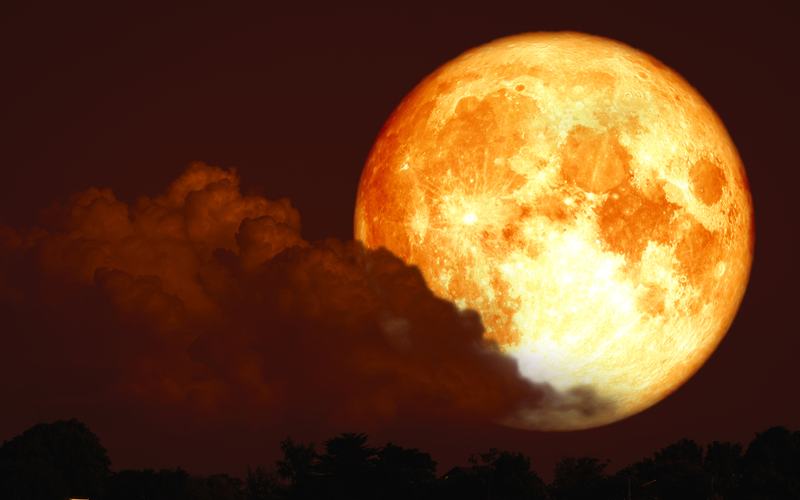
The total lunar eclipse of March 2-3, 2026, peaked at 6:33 a.m. EST on Tuesday, turning the full moon into a striking blood-red hue for skywatchers in North America. Known as a Blood Moon, the event occurred as the moon passed fully into Earth's shadow, with totality lasting 58 minutes.
The eclipse unfolded in phases starting late Monday night into early Tuesday morning for Eastern Time observers. Penumbral contact began at 3:44 a.m. EST, followed by partial eclipse at 4:50 a.m. EST. Totality started at 6:04 a.m. EST, with the greatest eclipse at 6:33 a.m. EST, before totality ended at 7:03 a.m. EST. The event wrapped up with a partial eclipse ending at 8:17 a.m. EST and penumbral at 9:23 a.m. EST.
In UTC terms, the greatest eclipse occurred at 11:33 UTC on March 3, with an umbral magnitude of 1.15263, meaning the moon was more than fully immersed in Earth's umbra. The red color results from sunlight refracting through Earth's atmosphere, filtering blue light and allowing longer red wavelengths to reach the moon's surface.
Visibility spanned northeast Asia, northwestern North America, the central Pacific Ocean, eastern Australia, and parts of South America. The eclipse was fully visible, rising over much of Asia and Australia and setting over the Americas. No view was available from Africa or most of Europe.
Observers needed no special equipment, though binoculars or telescopes enhanced the view of the darkened, coppery moon in the constellation Leo. Clear skies were key, with weather forecasts varying by region ahead of the event.
This eclipse belongs to Lunar Saros 133. The next lunar eclipse is a partial one on August 28, 2026, visible mainly over the Americas, Europe, Africa, and western Asia. At the current time, 9:04 p.m. EST on Monday, March 2, the event remained several hours away for East Coast viewers, who would need to rise early for the spectacle.

Comments
No comments yet. Be the first to share your thoughts.