
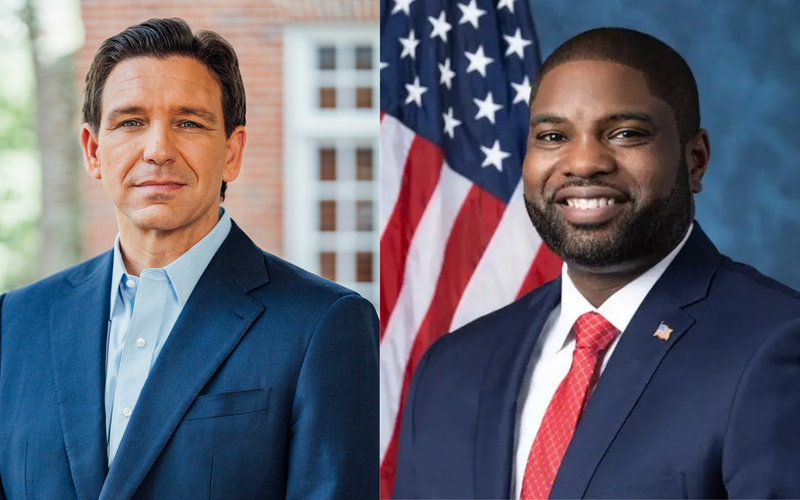
On Tuesday, Governor Ron DeSantis gave his official endorsement to Byron Donalds during a leadership forum in Tampa, putting an end to speculation about whom the term-limited governor would back.
Leading up to Tuesday, DeSantis kept silent about who he'd endorse ahead of the Republican primaries in August.
Following his leadership forum, the outgoing governor announced a sweeping list of endorsements, including Donalds, Attorney General James Uthmeier, Florida Chief Financial Officer Blaise Ingoglia, and Agriculture Commissioner Wilton Simpson.
Donalds acknowledged the endorsement in a post on X, writing, "Governor DeSantis has done incredible work to make Florida the envy of America. As your next Governor, I will build on his success and defend the Florida Dream."
The outgoing governor’s endorsement is among the many endorsements from high-ranking figures backing Donalds for governor, including President Donald Trump, Donald Trump Jr., Elon Musk, House Speaker Mike Johnson, and senators Rick Scott and Ted Cruz.
Donalds remained a strong backer of the president, standing on advancing his agenda if elected Florida’s governor. Heading into the Florida primaries, Donalds was perceived as the odds-on favorite to secure the Republican nomination, with late polling showing voters preferred him over his competitors, earning 41% support and leading second-place candidate Jay Collins, who received 15% support.
Collins, DeSantis’ Lieutenant Governor, however, had not been publicly endorsed by the governor heading into the primaries, instead focusing on Collins’ achievements during his tenure serving in the governor's cabinet.
Now that the stage has been set for the bid for governor, with Donalds facing Democratic challenger David Jolly in the November election, a question remains.
Why did DeSantis stall his endorsement of Donalds for so long?
A Strained Relationship Now Mended
Ron DeSantis and Byron Donalds both rose through Florida's Republican ranks as staunch conservatives with backgrounds in the Tea Party movement and the House Freedom Caucus.
Their paths intersected in 2018, when Donalds served on DeSantis' debate-preparation team during the gubernatorial race against Democrat Andrew Gillum.
DeSantis won narrowly with support from then-President Donald Trump and took office in 2019. Donalds later introduced DeSantis at his 2022 reelection victory event.
DeSantis appointed Donalds' wife, Erika, to help expand the state's school choice programs. Both men aligned on issues including tax cuts, border security, and opposition to certain federal regulations.
The relationship strained in 2023 when Donalds endorsed Trump for the Republican presidential nomination instead of DeSantis. Donalds also publicly criticized aspects of DeSantis-backed education standards on African American history.
DeSantis, who did not win the 2024 nomination, has since signaled unity with Donalds.
Why DeSantis’ Endorsement Matters
DeSantis holds a 57% job approval rating with 41% disapproving, according to a University of North Florida poll of likely midterm voters released in July.
The survey showed DeSantis performing well among his Republican base and holding solid support from independents. His numbers exceeded those of President Donald Trump in the same poll, who sat at 48% approval and 51% disapproval.
Heading into the elections, DeSantis spoke little on his relationship with Donalds, opting to call for Republican voters to continue the party’s momentum in Florida.
"I know that people have looked to Florida, and eight years ago, I remember everyone was always apprehensive about our elections. We knew we were this close in any election, from losing it," DeSantis said. "We knew that. Now we kind of feel like, 'Oh, we got a million and a half more Republicans. You know, we can't be beat.' And the reality is, that's only true if everybody shows up and everybody participates. And so I just hope that people understand, this November is important."
This call for unity by DeSantis could provide a much-needed boost for Donalds among voters who are skeptical of his commitment to Floridians. Party division can create an opportunity for Democrats to use a divide-and-conquer approach.
Jolly, heading into this election, is hoping to secure Republican voters who are no longer interested in Trump or those aligned with the president, like Donalds, while gathering support from stragglers and the Florida Democratic base.
DeSantis' term as governor ends in January 2027, positioning Donalds to potentially extend the state's conservative governance priorities.

Comments
No comments yet. Be the first to share your thoughts.