
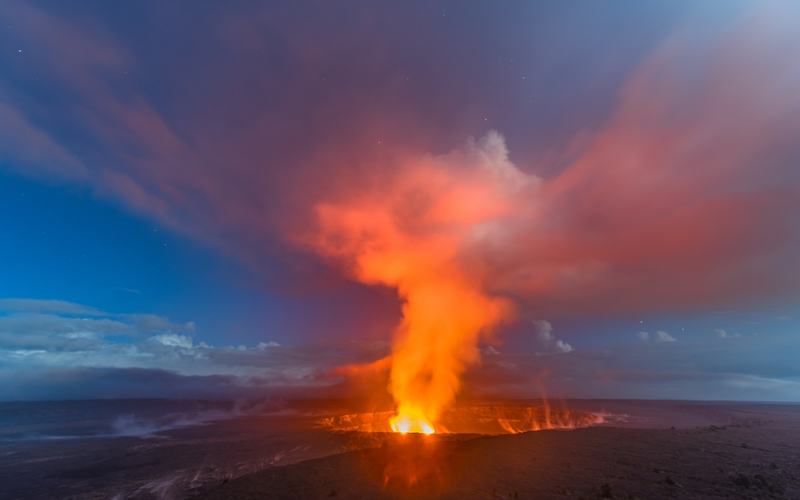
Kīlauea volcano concluded its 43rd eruptive episode after nearly nine hours of vigorous activity at the summit within Hawaiʻi Volcanoes National Park.
The episode began with precursory fountaining as dual north and south vents in Halemaʻumaʻu crater activated. Lava fountains peaked at over 1,300 feet (400 meters), with the south vent consistently taller than the north. At the height of the eruption, fountains exceeded 1,000 feet (300 meters), and the eruption's highest instantaneous effusion rate reached roughly 1,000 cubic yards (800 cubic meters) per second. Plumes rose above 30,000 feet (9,100 meters) above sea level, pushed north and east by light southwest winds.
Activity eventually waned, with fountains reaching about 500–600 feet (150–200 meters) in the final stage before both vents stopped abruptly. The episode produced an estimated 16 million cubic yards (12 million cubic meters) of lava, covering about 50% of the Halemaʻumaʻu crater floor. Since the eruption series began, the total volume now approaches 325 million cubic yards (250 million cubic meters).
Tephra fallout prompted swift responses. Pieces as large as footballs and up to 6 inches fell along the north caldera rim, Volcano Golf Course, Kīlauea Military Camp, and communities such as Volcano Village. Accumulations reached 4–7 inches at the Uēkahuna overlook and extended fine ash and Pele’s hair to the city of Hilo. The U.S. Geological Survey raised the volcano alert level to WARNING and the aviation color code to RED. Hawaiʻi Volcanoes National Park closed western overlooks and evacuated visitors, while Highway 11 shut between mile markers 23 and 40. The National Weather Service also issued an ashfall warning.
No injuries or structural damage to nearby communities were reported, as lava flows remained confined to the crater. Ongoing hazards include volcanic gas emissions forming vog downwind, potential crater wall instability, and rockfalls. The caldera rim has been closed since 2007.
The eruption is the latest in an ongoing series of 43 episodic events, all occurring within the national park and posing no threat to life or property outside the restricted areas.

Comments
No comments yet. Be the first to share your thoughts.