
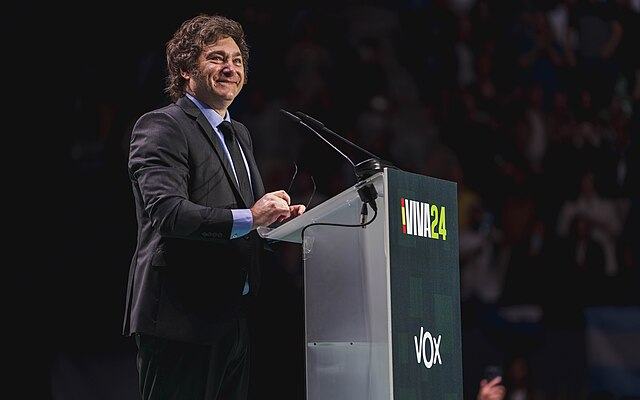
Argentine President Javier Milei said Sunday that he intends to formalize his country’s “strategic alliance” with the United States as enduring state policy, strengthening ties with President Donald Trump amid shifting geopolitical tensions.
Speaking during a state of the nation address before Congress in Buenos Aires, Milei argued that the South Atlantic will serve as a decisive arena in the coming decades and said Argentina must position itself as a central player in the region. He framed the Western Hemisphere as entering a defining era, declaring that the Americas should lead globally “from Alaska to Tierra del Fuego.”
Milei pointed to Argentina’s natural resource base as a strategic asset for the West, citing critical minerals, vast energy reserves including gas and oil, nuclear capacity, and renewable energy potential. He also highlighted the country’s geographic position at the southern tip of the continent, noting access to both the Atlantic and Pacific Oceans and a presence in Antarctica.
On foreign policy, Milei’s administration publicly supported Washington’s military strikes against Iran that began Saturday and placed Argentina on heightened alert. Argentina is home to the largest Jewish community in Latin America and has long accused Iran and the terrorist group Hezbollah of orchestrating the 1994 bombing of a Jewish community center in Buenos Aires that killed 85 people.
Domestically, Milei devoted much of his nearly two-hour speech to economic reforms he says have stabilized Argentina after years of inflation and financial turmoil. He announced a package of 90 additional reforms designed to “redesign” the country for the next half-century. The proposed measures are expected to address taxation, the criminal code, electoral rules, education, the judiciary, defense policy, and broader economic restructuring.
Milei described the coming months as a period of uninterrupted structural transformation aimed at reshaping Argentina’s institutional framework. His government begins the new legislative cycle in a strengthened political position following midterm election gains in October.
Last week, Congress approved Milei’s flagship labor reform measure, known as the “labor modernization law,” which loosens hiring regulations, expands permissible working hours, reduces severance obligations, limits strike rights, and lowers certain employer taxes. Supporters argue the changes will encourage job creation and investment, while critics have staged protests in recent weeks, contending the law rolls back worker protections.
With a reform mandate and a clear pro-American posture, Milei signaled that Argentina intends to pursue both domestic restructuring and deeper hemispheric alignment in the year ahead.

Comments
No comments yet. Be the first to share your thoughts.