
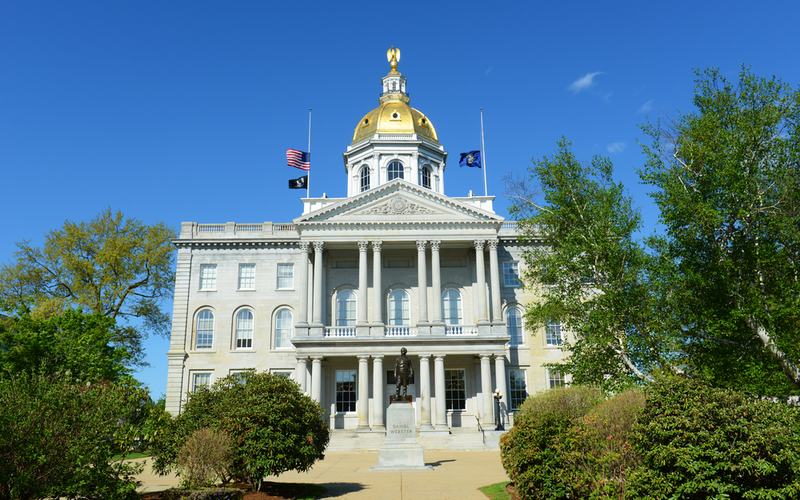
The New Hampshire House voted 188–165 on Thursday to advance House Bill 1793, legislation that would prohibit publicly funded colleges and universities from restricting the lawful possession or use of firearms, tasers, pepper spray, and other self-defense tools. The bill now heads to the Senate for review of any fiscal impact before a final vote.
The measure reverses policies implemented in the aftermath of the 2018 Parkland school shooting, when a bipartisan coalition rejected campus carry legislation amid national concern over gun violence. Republicans argue the move restores Second Amendment rights unfairly withheld from young adults.
State Representative Sam Farrington (R–NH), a University of New Hampshire student, led the effort, framing the issue as one of equal protection and fundamental rights. “College students are adults. They are entitled to the same protections under the law as every other citizen in New Hampshire,” Farrington said. He emphasized that self-defense is a natural right “granted by God alone,” not a government privilege.
New Hampshire currently allows open and concealed carry without a permit but has historically left campus weapon policies to individual institutions. The proposed legislation would remove that discretion for public colleges, aligning campus rules with broader state law. Farrington highlighted that students already exercise significant civic responsibilities, such as voting and military service, questioning why they should be considered too immature to carry for self-defense.
Democrats, including Representative David Meuse (D–NH), expressed concerns about safety in dormitories and classrooms, arguing that campus carry restrictions are location-based, not age-based. Republicans countered that gun-free zones leave law-abiding citizens defenseless without deterring criminals.
Supporters cited examples from 11 other states with campus carry laws, noting that predictions of increased campus violence have not materialized. Representative Jennifer Rhodes (R–NH) said similar policies elsewhere have not resulted in a rise in violent crime.
If the Senate, which currently has a 16–8 Republican majority, approves the bill, New Hampshire would mark a decisive reversal from its post-Parkland hesitation and send a clear message that constitutional rights extend to public college campuses.

Comments
No comments yet. Be the first to share your thoughts.