
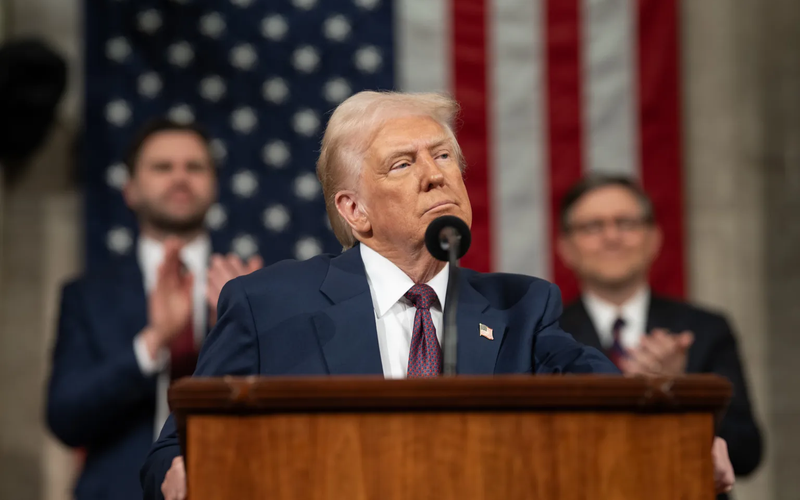
President Donald Trump called on lawmakers to immediately restore funding to the Department of Homeland Security, charging that Democrats are responsible for a partial shutdown affecting border security and counterterrorism functions.
Speaking during his State of the Union address, Trump told members of Congress that funding for the agency tasked with safeguarding the homeland had been halted. He framed the lapse as a direct threat to national security and public safety.
“As we speak, Democrats in this chamber have cut off all funding for the Department of Homeland Security,” Trump said. “They have closed the agency responsible for protecting Americans from terrorists and murderers. Tonight, I am demanding the full and immediate restoration of all funding for the Border Security and Homeland Security of the United States.”
The funding standoff centers on appropriations for border enforcement, immigration control, and internal security operations. The administration has argued that uninterrupted resources are necessary to maintain patrol operations, detention capacity, and investigative work tied to transnational crime and terrorism.
Republicans have maintained that the shutdown is the result of resistance from the Democratic Party over border policy priorities. Democrats, meanwhile, have raised objections to certain enforcement provisions and spending allocations tied to immigration measures.
The Department of Homeland Security oversees agencies including Customs and Border Protection, Immigration and Customs Enforcement, the Transportation Security Administration, and the Secret Service. Any prolonged disruption in funding could affect personnel scheduling, pay, and operational capacity across those divisions.
President Trump has urged lawmakers to act swiftly, arguing that border security should not be subject to partisan disputes. He emphasized that restoring full funding would ensure continuity in enforcement efforts and protect communities nationwide.
The address places renewed pressure on Congress to resolve the impasse as negotiations continue over broader federal spending legislation.

Comments
No comments yet. Be the first to share your thoughts.