
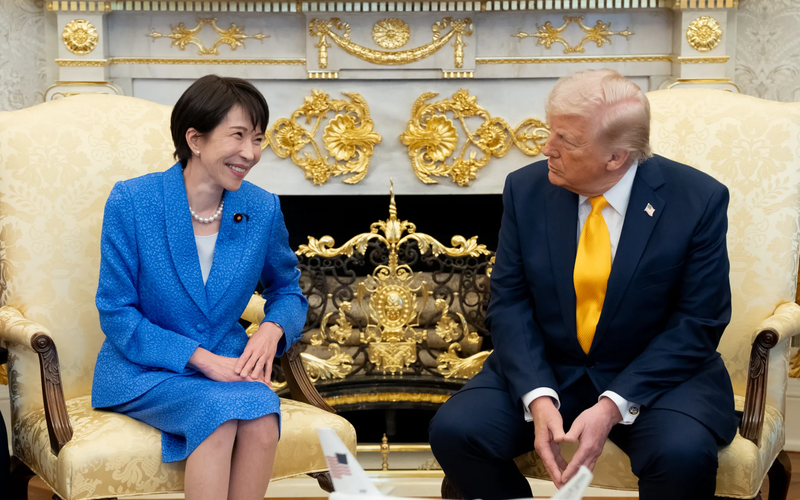
President Donald Trump hosted Japanese Prime Minister Sanae Takaichi at the White House on Thursday for an extended bilateral meeting that addressed the U.S.-Japan alliance amid escalating tensions from the Iran war.
The summit, originally scheduled to include a working lunch, saw the meal cancelled to allow for more discussion time, according to Japanese media reports. Trump and Takaichi met in the Oval Office, where the leaders fielded questions from reporters on key issues including the ongoing conflict in the Middle East.
Takaichi, Japan's first female prime minister elected in October 2025 and re-elected in February 2026 with a supermajority for her Liberal Democratic Party, arrived in Washington the previous day. Trump has previously praised her leadership, endorsing her ahead of Japan's snap elections.
The talks occurred against the backdrop of the U.S.-led war against Iran, which began on February 28 and has disrupted oil shipments through the Strait of Hormuz, a vital route for a fifth of global energy supplies that Japan heavily relies on. Trump pressed Japan to contribute more to securing the strait, stating during the meeting, “I expect Japan to step up because we have that kind of relationship, and we step up for Japan,” while noting the significant U.S. financial commitment to the alliance.
Takaichi acknowledged the meeting's challenges beforehand, telling reporters she anticipated a "very difficult" discussion and would clearly explain Japan's legal limitations on military involvement. Japanese officials confirmed no plans to dispatch warships to the strait currently, though survey or intelligence missions might be considered post-ceasefire. She emphasized the need for early de-escalation to protect Japan's economy, stating, "Without early de-escalation of the situation, our economy will be in trouble."
Other agenda items included trade, energy cooperation, and countering China's influence in the Indo-Pacific. The leaders discussed Japan's investments in U.S. oil production in Alaska, natural gas projects, and a $550 billion investment package. Security topics encompassed Japan's military buildup, missile deployments, and alliance commitments amid concerns over potential U.S. troop shifts from Asia to the Middle East.
Trump referenced historical U.S.-Japan ties during the exchange, including a light-hearted mention of Pearl Harbor in the context of alliance reciprocity. No formal agreements or joint statements were announced from the meeting as of Thursday afternoon.
The visit underscores the robust U.S.-Japan partnership, with prior collaborations on critical minerals and trade deals from Trump's October 2025 Tokyo trip. Takaichi aims to reaffirm Tokyo's role as a reliable ally while navigating domestic constraints on overseas military action.

Comments
No comments yet. Be the first to share your thoughts.