
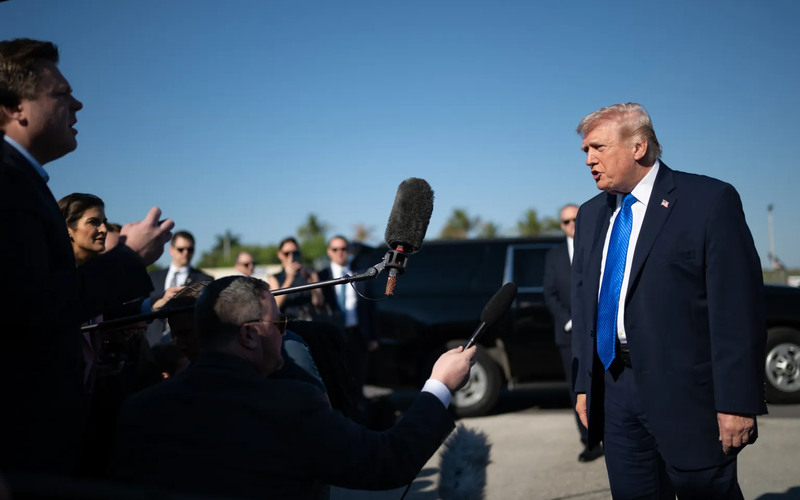
President Donald Trump announced Monday that he has instructed the U.S. military to pause all strikes on Iranian power plants and energy infrastructure for five days. The decision follows what Trump described as "very good and productive conversations" with Tehran over the past two days, aimed at resolving hostilities and reopening the Strait of Hormuz.
In a Truth Social post, Trump stated that the U.S. had engaged in "in-depth, detailed, and constructive conversations, which will continue throughout the week." He emphasized that Iran initiated contact, saying, "They called. I didn’t call." The pause is conditional on the success of ongoing discussions, with Trump noting potential agreements on Iran forgoing nuclear weapons and enriched uranium stockpiles.
The announcement came hours before a 48-hour ultimatum issued Saturday expired. Trump had warned Iran to fully reopen the Strait of Hormuz, a vital oil shipping route, or face strikes that would "obliterate" its power plants, starting with the largest. Iran closed the strait in retaliation after U.S. and Israeli strikes began on February 28, triggering a conflict now in its fourth week.
Iranian officials denied direct talks, with the Foreign Ministry claiming Trump's move sought to lower energy prices and delay military action. State media portrayed it as a U.S. retreat amid Tehran's warnings of retaliation against regional power grids, including those supplying U.S. bases. Indirect communications occurred through mediators such as Turkey, Egypt, and Pakistan, involving U.S. envoys Jared Kushner and Steve Witkoff, possibly with Iranian Parliament Speaker Mohammad Bagher Ghalibaf.
Markets reacted sharply. Oil prices plunged over 10 percent, with U.S. crude falling below $90 a barrel and Brent crude to around $100. Stock futures surged, the S&P 500 was up nearly 3 percent, and Dow futures were gaining 1,000 points. The Strait closure had disrupted 11 million barrels of oil daily, exacerbating a global energy crisis worse than past shocks, per the International Energy Agency. U.S. Treasury Secretary Scott Bessent announced eased sanctions on 140 million barrels of Iranian oil to stabilize prices.
The war has killed over 2,000 people, including more than 1,200 in Iran, 1,000 in Lebanon, 15 in Israel, and 13 U.S. service members. U.S. forces, including two aircraft carriers and incoming Marines, have targeted Iranian naval assets and missile sites. Israel continues strikes on Tehran and battles Hezbollah. Trump spoke with British Prime Minister Keir Starmer on the Strait, while German Chancellor Friedrich Merz welcomed the pause.
White House Press Secretary Karoline Leavitt called the discussions sensitive, declining to provide details on intermediaries. U.N. officials urged de-escalation, warning strikes on energy sites could violate international law.

Comments
No comments yet. Be the first to share your thoughts.