
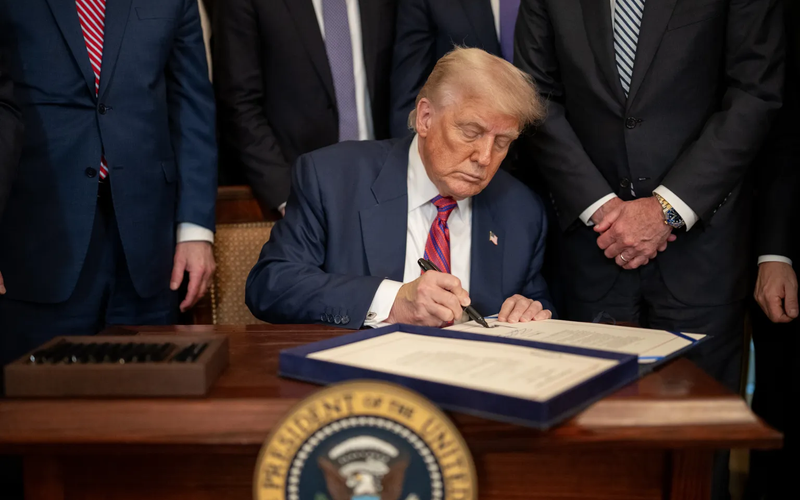
President Donald Trump on Friday signed an executive order aimed at tightening oversight of college athletics, directing federal agencies to reinforce rules governing athlete compensation, transfers, and eligibility.
The order seeks to strengthen enforcement of existing standards while calling for new guidelines to address what the administration views as growing instability in college sports. It directs agencies to evaluate whether violations of these rules could make universities ineligible for federal grants and contracts.
The directive also urges governing bodies, including the NCAA, to establish clearer eligibility limits, formalize transfer regulations, and prohibit what it describes as “improper” financial arrangements, specifically targeting pay-for-play deals facilitated by booster-backed collectives.
In addition, the order calls on Congress to pass legislation addressing the rapid changes in college athletics, particularly surrounding name, image, and likeness (NIL) compensation.
Trump has increasingly focused on the issue in recent months, arguing that the surge in NIL deals, especially in major revenue sports like football and men’s basketball, has created financial strain for schools and threatens the viability of non-revenue programs, including many women’s sports.
The executive action follows a prior order issued in July that attempted to limit certain third-party recruiting payments. Trump indicated at the time that a broader effort would follow.
The landscape of college athletics shifted significantly after a 2021 Supreme Court ruling led the NCAA to allow athletes to profit from their name, image, and likeness. Since then, NIL compensation has grown rapidly, with top athletes securing lucrative endorsement deals.
While football and basketball dominate revenue and attention, college sports programs collectively support more than 500,000 student-athletes and provide nearly $4 billion annually in scholarships. Many Olympic athletes also emerge from collegiate programs, underscoring broader concerns about maintaining balance across all sports.
The administration argues the new order is necessary to preserve competitive integrity and long-term sustainability, though any lasting changes will likely depend on congressional action and cooperation from athletic governing bodies.

Comments
No comments yet. Be the first to share your thoughts.