
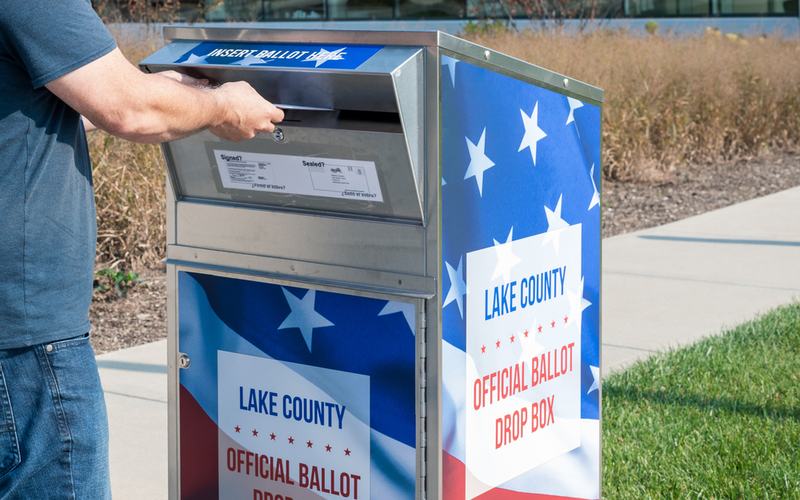
President Donald Trump signed an executive order on Tuesday titled "Ensuring Citizenship Verification and Integrity in Federal Elections," directing federal agencies to create state-specific lists of verified U.S. citizens eligible to vote and imposing new safeguards on mail-in and absentee ballots.
The order, signed in the Oval Office during a ceremony streamed live, requires the Department of Homeland Security and Social Security Administration to compile and transmit "State Citizenship Lists" to each state's chief election official at least 60 days before federal elections. These lists identify confirmed U.S. citizens who will be 18 or older and reside in the state, using federal databases like the SAVE program. States and individuals can update or correct the lists, but inclusion does not automatically register voters.
A key provision targets mail-in voting by ordering the Postmaster General to initiate rulemaking within 60 days. All USPS-transmitted absentee ballots must use secure envelopes marked "Official Election Mail" with unique Intelligent Mail barcodes for tracking. Crucially, the USPS cannot send ballots to individuals unless they are enrolled on a state-specific "Mail-in and Absentee Participation List," which states can supplement before elections.
The Attorney General must prioritize prosecutions of election officials or others who issue ballots to ineligible voters and coordinate withholding federal funds from noncompliant states. The measure builds on Trump's March 2025 executive order, which enforced Election Day ballot receipt deadlines and promoted paper ballots with voter-verifiable records.
Trump, speaking at the signing, stated, "We want to have honest voting in our country because if you don't have honest voting, you can't have really a nation." The White House fact sheet described the action as fulfilling Trump's 2024 campaign promise to secure elections and contrasted it with practices in countries like Denmark and Sweden, which limit mail-in voting.
The executive order arrives amid preparations for the November 2026 midterm elections, where Republicans aim to maintain congressional majorities. Trump has long criticized mail-in voting, citing unsubstantiated 2020 fraud claims that fueled his election challenges. A White House fact sheet noted ongoing issues with lax verification and self-attestation in voter registration.
Democrats and voting rights advocates swiftly condemned the order. The Brennan Center called it an "unprecedented" power grab, predicting lawsuits over states' constitutional authority to administer elections. NPR reported experts view it as likely unconstitutional, given presidential limits on election rules. Republicans praised it as essential for preventing non-citizen voting and fraud. Supporters highlighted tools like SAVE to bolster public confidence without disenfranchising citizens.
Legal challenges are expected immediately, similar to those blocking parts of the 2025 order. The Supreme Court recently heard arguments on state mail ballot deadlines, signaling ongoing battles. Implementation timelines include USPS final rules within 120 days and DHS infrastructure within 90 days.

Comments
No comments yet. Be the first to share your thoughts.