
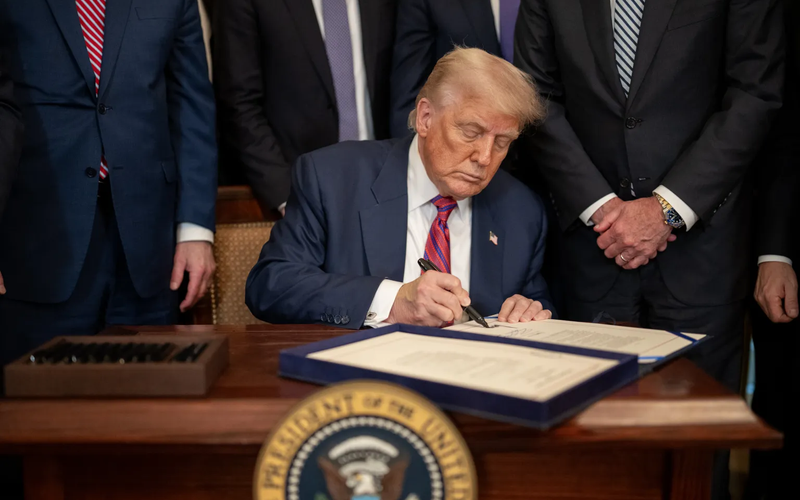
President Donald Trump signed an executive order on Tuesday directing the Department of Homeland Security and the Social Security Administration to compile a nationwide list of verified eligible voters, including lists for each state. The move aims to bolster election integrity ahead of the 2026 midterm elections by restricting mail-in ballots and enhancing tracking measures.
The order instructs the U.S. Postal Service to refrain from delivering absentee ballots to individuals not on a state's approved voter list. It also requires ballots to use secure envelopes equipped with unique barcodes for tracking purposes. Federal funding could be withheld from non-compliant states and localities, according to reports. Trump made the announcement in the Oval Office, stating, "The cheating on mail-in voting is legendary. It's horrible what's going on." He added, "I think this will help a lot with elections."
This executive action builds on Trump's long-standing concerns about voter fraud, particularly with mail-in voting, which he has raised since the 2020 election. The administration has previously pursued similar efforts, including a March 2025 executive order that mandated proof-of-citizenship for federal voter registration and tighter deadlines for mailed ballots. That earlier order faced court blocks from voting rights groups and Democratic attorneys general. Recent actions include Justice Department requests for state voter rolls and FBI involvement in ballot reviews.
The order leverages federal databases like the DHS's SAVE system for citizenship verification to maintain accurate voter rolls, aligning with requirements under the National Voter Registration Act and Help America Vote Act. Trump has pushed these measures amid stalled legislative efforts, such as the SAVE America Act, which sought photo ID and citizenship proof for federal voting but lacked Senate support.
Supporters view the order as a necessary step to prevent fraud, citing Trump's repeated assertions of irregularities in past elections. A 2025 Brookings Institution report noted extremely low instances of mail ballot fraud, at about 0.000043%.
As midterm campaigns intensify, the order underscores ongoing partisan divides over election security. Trump recently used mail-in voting himself for a Florida election, supporting limited use for specific cases like military or travel, but opposing universal access.

Comments
No comments yet. Be the first to share your thoughts.