
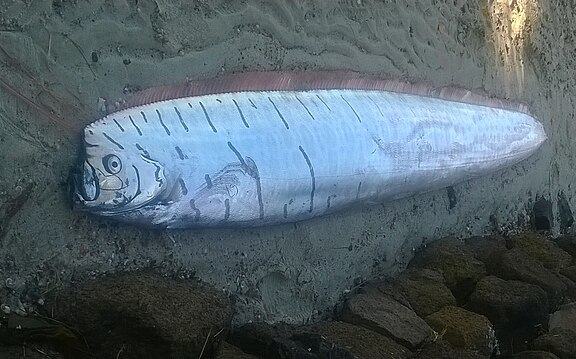
Two rare deep-sea oarfish washed ashore on a beach in Cabo San Lucas, Mexico, where tourists stepped in to help guide the struggling creatures back into the ocean.
The unusual encounter was captured on video by beachgoer Monica Pittenger, who said she and her sister initially spotted something unusual shimmering in the distance. As they moved closer, they realized the long, ribbon-shaped fish were alive but struggling near the shoreline.
“We saw something in the distance, it was flashing, and it was really bright,” Pittenger said. “When we saw them up close, it was like nothing we’ve seen before, so we were like, this can’t be real.”
Video from the scene shows several people working together to carefully push one of the fish back toward deeper water. Pittenger said her sister quickly reacted after seeing the animal in distress, placing her hands under the fish and guiding it toward the ocean with the help of another beachgoer.
The rescue effort continued after a second oarfish was discovered washed up nearby. According to Pittenger, both fish were eventually returned to the water and swam away.
Oarfish are rarely seen by humans because they typically live deep in the ocean, sometimes thousands of feet below the surface. According to the Ocean Conservancy, the fish can grow as long as 30 feet and feed mainly on plankton, krill, and small crustaceans. Their long, flat bodies and unusual swimming motion are believed to be the origin of their name.
The species is sometimes referred to as the “doomsday fish” in folklore. In parts of the world, sightings of oarfish near shore have historically been associated with superstitions about natural disasters. Reports have noted that multiple oarfish appeared along Japanese coasts before the devastating 2011 earthquake, although scientists say there is no confirmed link between the fish and seismic activity.
Oarfish are also known as the “king of the herrings,” ribbonfish, or streamer fish. Marine researchers note that their unusual appearance and enormous size may have contributed to historical sea-monster legends.

Comments
No comments yet. Be the first to share your thoughts.