
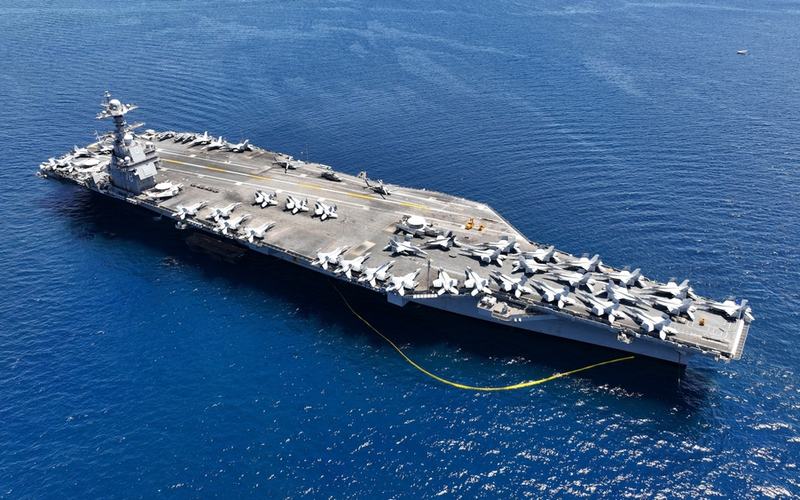
The Pentagon's Director of Operational Test and Evaluation released its Fiscal Year 2025 Annual Report last week, highlighting ongoing testing shortfalls for the Gerald R. Ford-class aircraft carriers. The report noted that critical events remain to fully assess the class's operational effectiveness, suitability, and survivability, even as USS Gerald R. Ford (CVN-78) completed a pre-deployment workup and conducted operations in fiscal 2025.
DOT&E reported that Initial Operational Test and Evaluation for CVN-78 began in September 2022 and is slated for completion in fiscal 2027. Key pending tests include a live demonstration of the ship's sortie generation rate, delayed from fiscal 2025 to 2026 due to maintenance issues, along with Ship Self-Defense System evaluations and underway cyber survivability testing. The office cited insufficient data to evaluate effectiveness and suitability, pointing to low reliability in systems like the Electromagnetic Aircraft Launch System, Advanced Arresting Gear, and Advanced Weapons Elevators, which impact flight operations and sortie generation.
A Total Ship Survivability Trial in January 2025 demonstrated robust damage control capabilities but revealed limitations from undiscovered system interdependencies. Berthing shortfalls of 159 beds at full manning were also flagged, affecting crew quality of life during sustained missions. During fiscal 2025 operations, the ship and air wing met combatant commander taskings but fell short of fully representative Key Performance Parameters.
These findings come as USS Gerald R. Ford endures one of the longest deployments in modern U.S. Navy history. The carrier departed Norfolk on June 24, 2025, initially for the Mediterranean before shifting to the Caribbean for operations against Venezuelan threats and then to the Middle East for U.S.-Israeli strikes against Iran under Operation Epic Fury. As of mid-March 2026, the deployment exceeded 260 days, with Vice Chief of Naval Operations Adm. James Kilby confirming a return no earlier than May.
The ship faced challenges during this period, including a March 12 fire in the main laundry spaces that injured two sailors with non-life-threatening injuries and displaced hundreds from their bunks. U.S. Central Command stated the fire was contained with no propulsion damage, and the carrier remained fully operational before heading to Souda Bay, Greece, for repairs. Ongoing sewage system breakdowns, linked to design flaws in the vacuum toilet system, have required daily maintenance and exacerbated hygiene issues under high operational tempo.
Navy officials emphasized crew resilience. A February statement praised Ford's team for demonstrating "resilience, readiness during extended deploy." Chief of Naval Operations Adm. Daryl Caudle noted improvements in maintenance issues amid the deployment. Joint Chiefs Chairman Gen. Dan Caine commended the strike group for standing the watch despite extensions.
The Ford-class, designed to reduce manning by 15 percent and boost sortie rates, represents a generational leap but continues to address early-program challenges. DOT&E oversight persists until full testing concludes.

Comments
No comments yet. Be the first to share your thoughts.