
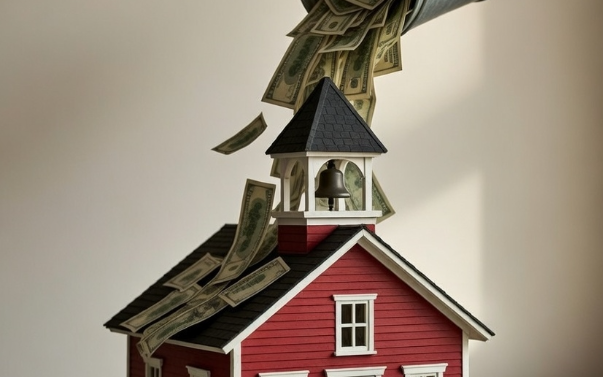
Education funding consumes roughly half of every state's budget on average, making it one of the largest line items in public spending across America. In the 2020–21 school year, public elementary and secondary schools nationwide spent a staggering $927 billion, averaging $18,614 per pupil in constant 2022–23 dollars. That's higher than ever before, with current expenditures per pupil rising 13% from 2010–11 to 2020–21 after inflation adjustments. Yet, amid this torrent of taxpayer dollars, we see teacher strikes, union rallies, and impassioned pleas from politicians for even more funding—as if the solution to stagnant student outcomes is always just one more budget boost away.
Take the teacher strikes that swept states like West Virginia, Oklahoma, and Arizona in 2018, demanding higher pay and more resources. Unions framed these as desperate cries for "investing in our kids," while lawmakers often echo the call, promising that increased spending will be the key to better schools. But is this love affair with ever-growing education budgets delivering results? Or are we pouring more money into a system that's efficient at growing bureaucracy but not at educating children? The dirty little secret is that district superintendents and boards decide how to spend the money for their schools. If voters aren’t happy about that, they should be taking it up with the district, not necessarily the legislature.
Proponents of ramping up K-12 funding have a straightforward pitch: schools are under-resourced, and more money means better outcomes. Nationally, per-pupil spending has climbed steadily, from $14,453 in 2010–11 to $16,280 in 2020–21 (in constant dollars), with states like New York leading at over $30,000 per student in recent years. In Mississippi, for instance, advocates argue that chronic underfunding has left classrooms starved of basics like updated textbooks and technology, leading to pleas for voters to "research, vote, and support public education" to boost teacher salaries and resources. An op-ed in The Meridian Star emphasizes that Mississippi's low per-pupil spending—around $12,000 nationally, but still below peers—contributes to teacher shortages and outdated facilities, urging a moral imperative to invest more to "give our children the best possible education."
This narrative often conflates "education funding" with direct classroom benefits, like teacher pay or smaller class sizes. Unions and policymakers insist that without constant increases, schools can't compete for talent or provide equitable opportunities, especially in low-income areas. "Schools need more money" is the refrain—we'll know we've spent enough when results improve, but until then, the end is never in sight. Simplistic? Perhaps, but it's effective rhetoric, especially when tied to emotional appeals about "our kids' future."
Examples abound: California's per-pupil spending hit $25,941 in 2023, up significantly from prior decades, fueled by arguments that more funds are essential for diverse student needs. In Vermont, advocates push for hikes beyond its already high $29,169 per student, claiming it's necessary to maintain quality in rural districts. The logic: Spend more now to avoid long-term societal costs like higher crime or unemployment from undereducated graduates.
Yet, despite these increases, student achievement hasn't kept pace. National Assessment of Educational Progress (NAEP) scores have remained largely stagnant in reading and math for fourth- and eighth-graders from 2009 to 2019, even as spending rose. In Mississippi, for example, Auditor General Shad White has highlighted how the state poured billions more into education over decades without proportional gains, calling it inefficient and urging accountability over blank checks. White's critiques underscore a broader counter-narrative: More money often feeds bureaucracy, not classrooms.
Economist Benjamin Scafidi's research reveals the bloat vividly. From 1992 to 2014, per-pupil spending jumped 27%, but teacher salaries fell 2% amid a 45% surge in non-teaching staff—administrators, aides, and others—outpacing student growth by more than double. If non-teaching hires had matched enrollment increases, schools could have redirected $24.3 billion annually toward teacher raises or student scholarships. Scafidi's work on charter schools also highlights an actual, realized efficiency: Charters deliver better ROI, being 35% more cost-effective than districts, often by prioritizing instruction over overhead.
The Covid-19 pandemic amplified the inefficiencies of districts. America's school districts received over $190 billion in federal aid through programs like ESSER, ostensibly to address learning loss and safety. But as detailed in the white paper I authored for Educational Freedom Institute, "Are Our Schools Sick?", much of this windfall perpetuated pre-existing poor spending habits. Districts ramped up non-teaching hires and administrative costs, with staffing bloat consuming funds that could have gone to direct student supports. The paper assesses district "health" through metrics like achievement gaps and fiscal sustainability, concluding that without reforms, schools face a looming fiscal cliff as temporary aid expires—potentially leading to cuts in essential programs while outcomes remain flat.
Matt Ladner's analyses reinforce this. In Mississippi, despite low spending ($12,000 per pupil), the state saw NAEP gains in fourth-grade reading since 2013, climbing national averages through reforms like phonics-focused curricula and third-grade reading gates. Ladner notes states boosting spending most over the last two decades saw no equivalent achievement jumps, suggesting diminishing returns. His work on school choice links more options to higher NAEP performance, even in low-spend states like Florida and Texas.
Nationally, eight states exceeded $25,000 per pupil in 2023—New York ($36,976), New Jersey ($30,267), Vermont ($29,169)—yet outcomes lag behind lower-spenders like Mississippi, where targeted efficiency drove some progress. The argument: Money matters, but how it's spent matters more. Bloat in staffing (non-teachers up 45%) diverts funds from classrooms, per Scafidi. Ladner's correlations show choice, not cash, correlates with NAEP success. And as "Are Our Schools Sick?" warns, Covid-era infusions masked systemic issues, setting up districts for painful reckonings without structural changes.
America's K-12 spending spree—now nearing $1 trillion annually—hasn't bought the results we'd expect. While advocates insist on more funding to "support our kids," evidence from stagnant NAEP scores and inefficient allocation tells a different story. States like Mississippi show that targeted reforms, even in low-spend environments, can drive progress—but they're no cure-all. Covid funding's fiscal cliff, as highlighted in recent analyses, underscores the poor results that came about from allowing the government schools to maintain their monopoly for 100 years. It's time to prioritize efficiency, empower families with choice, and hold systems accountable. More money without reform is just more of the same: spending big and getting less. Taxpayers—and students—deserve better.
Comments
No comments yet. Be the first to share your thoughts.