
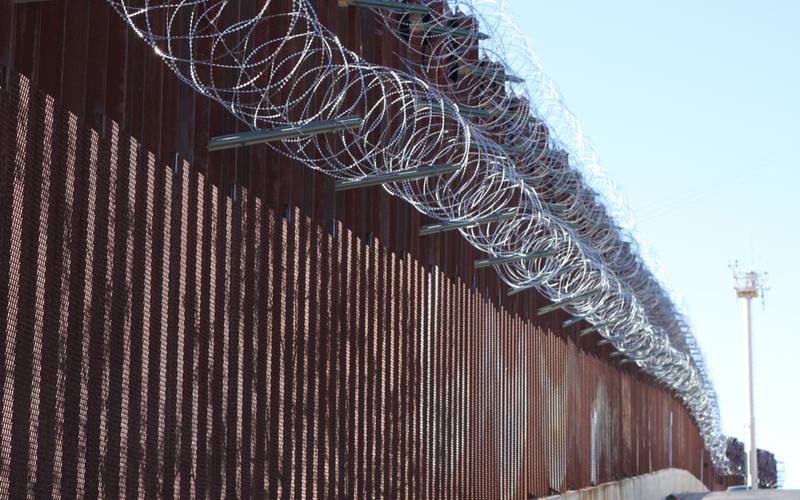
The U.S. Supreme Court heard oral arguments on Tuesday in Noem v. Al Otro Lado, a case that will determine whether federal immigration law allows border officials to turn away asylum seekers who present themselves at ports of entry along the U.S.-Mexico border.
At issue is the Trump administration's defense of a longstanding policy known as "metering" or turnbacks. The practice began in 2016 under the Obama administration at the San Ysidro port near San Diego amid a surge of Haitian migrants. It expanded across all southwest border ports in 2017 and was formalized in a 2018 Department of Homeland Security memorandum. Officials limited daily processing due to capacity constraints, requiring migrants without valid documents to wait in Mexico.
The Biden administration rescinded the policy in November 2021. The current Trump administration, in its second term, seeks to preserve the option to reinstate it as a tool to manage border surges and prevent overcrowding at facilities. U.S. Solicitor General D. John Sauer argued that migrants stopped in Mexico have not "arrived in the United States," as required by statute for asylum eligibility. "In ordinary English, a person ‘arrives in’ a country only when he comes within its borders," Sauer wrote.
Challengers, led by the immigrant rights group Al Otro Lado and individual asylum seekers, sued in the U.S. District Court for the Southern District of California. The district court ruled the policy unlawful under the Administrative Procedure Act. A divided panel of the U.S. Court of Appeals for the 9th Circuit largely upheld that decision in 2024, finding that migrants who approach ports of entry have "arrived in the United States" regardless of which side of the border they stand on. Judge Michelle Friedland wrote for the majority: "The phrase ‘arrives in the United States’ encompasses those who encounter officials at the border, whichever side of the border they are standing on."
Judge Daniel Bress dissented, joined by 11 others, calling the ruling a violation of statutory text and precedent, including the Supreme Court's 1993 decision in Sale v. Haitian Centers Council, which held immigration laws do not apply extraterritorially to refugees intercepted at sea. The full 9th Circuit denied rehearing. The Supreme Court granted certiorari in November 2025.
The central question turns on the Immigration and Nationality Act's language allowing asylum for those "physically present in the United States" or who "arrive in the United States." The government invokes the presumption against extraterritoriality, arguing the law applies only to those within U.S. borders. Challengers contend the present-tense phrasing covers those presenting at ports, consistent with regulations since 1917, and that metering creates unsafe conditions in Mexico while incentivizing illegal crossings between ports.
Melissa Crow of the Center for Gender & Refugee Studies said the policy allows officials to "slam the door on asylum-seekers" despite capacity. One asylee described being turned away repeatedly after surviving torture.
The case arrives amid the Trump administration's aggressive immigration enforcement, including firings of immigration judges and instructions to limit asylum grants. The Court recently ruled unanimously on March 4 that federal appeals courts must defer to immigration judges on persecution findings in asylum cases, bolstering executive authority. A decision is expected by July.

Comments
No comments yet. Be the first to share your thoughts.