
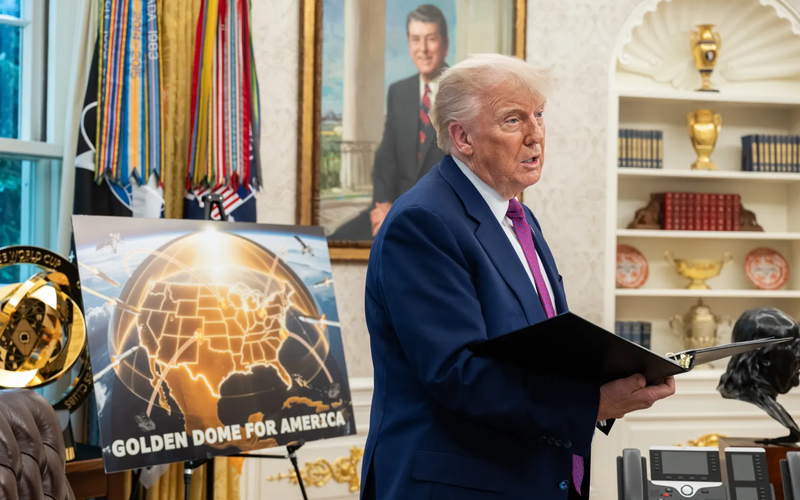
The U.S. Space Force awarded 20 Other Transaction Authority agreements worth up to $3.2 billion to 12 companies Friday to develop prototypes for space-based interceptors under the Golden Dome missile defense program.
The contracts, signed in late 2025 and early 2026 by the Space Systems Command, target the creation of a proliferated low-Earth orbit constellation of interceptors. These systems would engage missiles during boost, midcourse, and glide phases to counter threats with increasing speed, maneuverability, and lethality, integrated with advanced tracking and artificial intelligence.
The 12 companies receiving the awards are Anduril Industries Inc., Booz Allen Hamilton Inc., General Dynamics Mission Systems Inc., GITAI USA Inc., Lockheed Martin Corp., Northrop Grumman Systems Corp., Quindar Inc., Raytheon Co., Sci-Tec Inc., SpaceX, True Anomaly Inc. and Turion Space Corp.
Col. Bryon McClain, program executive officer for space combat power, stated the awards harness American innovation and ensure continuous competition. "Adversary capabilities are advancing rapidly, and our acquisition strategies must move even faster to counter the growing speed and maneuverability of modern missile threats," McClain said. "With the commitment and collaboration of these industry partners, the Space Force will demonstrate an initial capability in 2028."
The Golden Dome initiative, announced by President Donald Trump last year, aims to build a layered shield protecting the U.S. homeland from ballistic, hypersonic, and cruise missile threats. It integrates ground-, air-, and space-based sensors and interceptors into a single network, with space-based interceptors representing a key technical challenge. Overall program costs are estimated at around $185 billion.
Gen. Michael Guetlein, who leads the Golden Dome program office, has emphasized affordability and scalability. "If boost-phase intercept from space is not affordable and scalable, we will not produce it because we have other options to get after it," Guetlein said in recent testimony.
The Space Force issued solicitations last year following Trump's announcement on May 20, 2025. The mix of traditional defense contractors like Lockheed Martin and Northrop Grumman with innovative firms such as SpaceX and Anduril reflects a strategy to accelerate development through competition.
Lawmakers approved $150 billion in defense funding last year, including $25 billion for Golden Dome. The Pentagon has requested nearly $400 million for the program in the fiscal 2027 base budget, plus more than $17 billion in a separate bill, including $4.5 billion for space efforts.
Proponents argue the system addresses gaps in current defenses against advanced threats, while critics have raised concerns over potential costs ranging up to trillions for a full interceptor fleet.

Comments
No comments yet. Be the first to share your thoughts.