
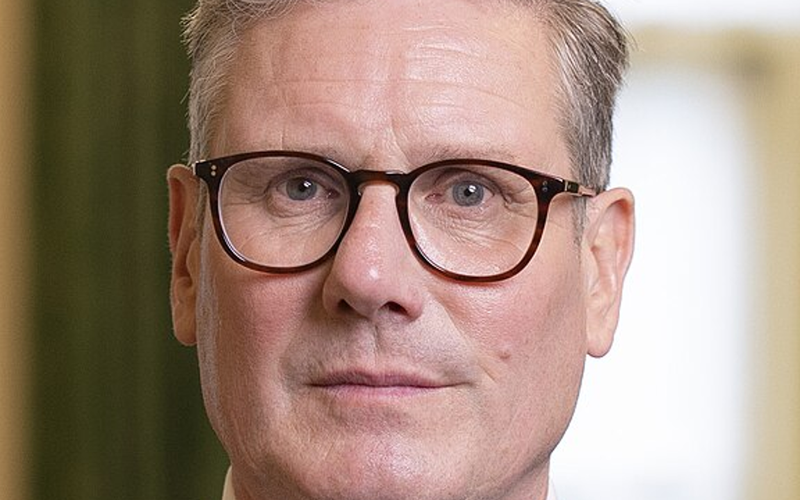
UK Prime Minister Keir Starmer warned Vladimir Putin could reinvade Ukraine absent strong US security guarantees during a ceasefire or peace deal.
Speaking to reporters aboard his flight to Washington on February 26, 2025, Starmer expressed concern that without a deterrent, Russia would exploit any pause in fighting. "The security guarantee has to be sufficient to deter Putin from coming again, because my concern is if there is a ceasefire without a backstop, it will simply give him the opportunity to wait and to come again because his ambition in relation to Ukraine is pretty obvious for all to see," he said.
Starmer arrived in Washington for high-stakes discussions with US President Donald Trump, pushing for American support behind a proposed British- and French-led peacekeeping mission in a postwar Ukraine. He committed UK troops to the effort but conditioned it on US provision of air cover, logistics, and communications.
The remarks followed Trump's rejection of broad security commitments in his first cabinet meeting the previous day. "I’m not going to make security guarantees, beyond — very much. We’re going to have Europe do that," Trump stated, emphasizing Europe's proximity and announcing a framework deal with Ukraine President Volodymyr Zelenskyy for access to rare earth minerals.
Starmer underscored Russia's role as the aggressor. "There’s one aggressor here and that’s Russia, in clear breach of the UN charter. Russia can end this conflict tomorrow by withdrawing and stopping their aggression," he added.
The meeting came amid fragile European security dynamics. French President Emmanuel Macron had cautioned Trump against any "surrender" of Ukraine days earlier, while Zelenskyy was scheduled to visit the White House the following day to finalize the minerals agreement, which now includes language on future security assurances.
UK officials tempered expectations for an immediate breakthrough, citing Trump's rhetoric but noting his stated aim to end the war. Starmer also announced Britain's largest defense spending increase since the Cold War, targeting 2.5% of GDP by 2027 and aspiring to 3%, funded partly by foreign aid reductions.
Russia's Foreign Minister Sergei Lavrov dismissed European peacekeeping proposals as a ploy to prolong the conflict. The talks extended beyond Ukraine to trade issues and the Chagos Islands sovereignty dispute.
A year later, on the fourth anniversary of Russia's full-scale invasion, Starmer reaffirmed unwavering UK support, announcing new aid packages including £20 million for energy infrastructure and military training. "We will stand by their side, until a just and lasting peace – and beyond," he said, echoing concerns over long-term Russian threats.

.jpg)
Comments
No comments yet. Be the first to share your thoughts.