
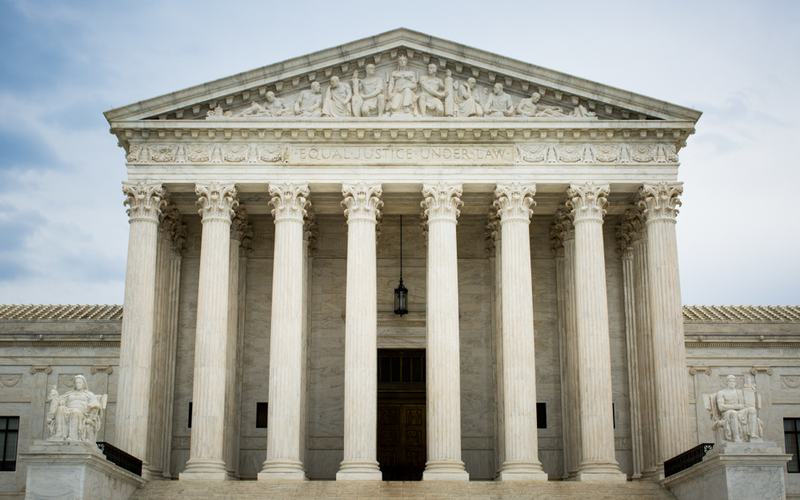
The Supreme Court will hear oral arguments on Monday in United States v. Hemani, a case examining whether a longstanding federal law barring unlawful drug users from possessing firearms violates the Second Amendment.
Federal agents searched the home of Ali Danial Hemani in Texas and discovered a Glock 19 9mm pistol, 60 grams of marijuana, and 4.7 grams of cocaine. Hemani admitted to using marijuana roughly every other day. Prosecutors charged him under 18 U.S.C. § 922(g)(3), which prohibits anyone who is an "unlawful user of or addicted to any controlled substance" from possessing firearms or ammunition, a felony punishable by up to 15 years in prison.
A federal district judge dismissed the indictment, ruling the law unconstitutional as applied to Hemani because he was not under the influence at the time. The U.S. Court of Appeals for the 5th Circuit affirmed in an unsigned opinion on January 31, 2025, citing its prior decision in United States v. Connelly that the statute does not apply to non-impaired marijuana users. The Supreme Court granted certiorari in October 2025 and set arguments for March 2, 2026.
Enacted in 1968 as part of the Gun Control Act, § 922(g)(3) has led to about 300 prosecutions annually and more than 240,000 firearm purchase denials since 1998 due to drug-related issues on background check forms. The provision targets users of any controlled substance, including marijuana, which remains federally illegal despite legalization for medical use in 40 states and recreational use in about half.
The case arises from post-2022 developments following New York State Rifle & Pistol Association v. Bruen, which requires gun regulations to align with the nation's historical tradition of firearm regulation. Lower courts have split, with some, like the 5th Circuit, limiting the ban to intoxicated individuals, while others uphold it for habitual users.
The Trump administration argues the law is constitutional, analogizing it to founding-era restrictions on "habitual drunkards" and those carrying arms while intoxicated. It contends the prohibition is temporary, ending when habitual use stops, and cites modern laws in 43 states restricting firearms for drug users. A separate process allows prohibited persons to seek ATF relief, though applications have been pending for decades.
Hemani's lawyers counter that the statute is unconstitutionally vague, failing to define "unlawful user" regarding frequency, recency, or quantity. They argue that no historical tradition supports disarming sober, non-addicted users and that equating marijuana use to 18th-century drunkard laws is flawed, as moderate drinkers were not barred.
The Justice Department recently told the court the ban must stand even if marijuana rescheduling proceeds under the Trump administration. Law enforcement officials express safety concerns about armed drug users, while advocates note inconsistencies, such as allowing oxycodone prescription holders to own guns.
A decision, expected by late June, could clarify Second Amendment limits on categorical disarmament and affect millions of cannabis users nationwide, particularly in states with legal markets.

Comments
No comments yet. Be the first to share your thoughts.