
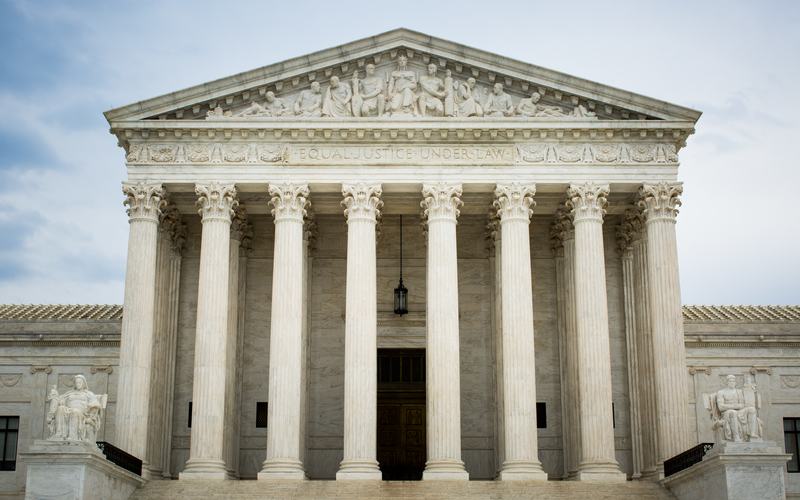
The Supreme Court ruled 6–3 on Friday that the International Emergency Economic Powers Act does not authorize the president to impose sweeping tariffs, invalidating a series of import duties enacted under President Donald Trump.
The case centered on Trump’s use of IEEPA after returning to office in 2025, when he declared national emergencies related to drug trafficking from Canada, Mexico, and China, as well as longstanding trade imbalances. Under that authority, the administration imposed a 25 percent duty on most imports from Canada and Mexico and a 10 percent levy on most Chinese goods. Additional “reciprocal” tariffs of at least 10 percent were later applied to imports from numerous trading partners, with combined rates on some Chinese products rising as high as 145 percent.
In a consolidated decision involving Learning Resources, Inc. v. Trump and Trump v. V.O.S. Selections, Inc., the Court held that Congress did not grant the executive branch authority to levy tariffs of “unlimited amount, duration, and scope” under IEEPA.
Chief Justice John Roberts, writing for the Court in key portions of the opinion, grounded the ruling in Article I of the Constitution, which assigns Congress the power to “lay and collect Taxes, Duties, Imposts and Excises.” The administration acknowledged that the president has no inherent peacetime authority to impose tariffs and instead relied exclusively on IEEPA’s language permitting the regulation of importation.
The majority rejected the argument that this phrasing includes broad tariff-setting power. Applying the major questions doctrine, the Court said it would not interpret ambiguous statutory language as granting sweeping economic authority of vast political significance without a clear statement from Congress.
The opinion also noted that in nearly five decades since IEEPA’s enactment, no president had used the statute to impose tariffs of this scale, underscoring the lack of historical precedent for the administration’s position.
Justices Neil Gorsuch and Amy Coney Barrett joined Roberts in applying the major questions framework. Justice Elena Kagan, joined by Justices Sonia Sotomayor and Ketanji Brown Jackson, agreed with the outcome but wrote that traditional statutory interpretation was sufficient. Justice Jackson also filed a separate opinion addressing legislative history.
Justice Clarence Thomas dissented, and Justice Brett Kavanaugh authored a separate dissent joined by Thomas and Justice Samuel Alito, arguing that the statute’s language was broad enough to encompass tariff measures and cautioning that the majority’s reasoning limits executive flexibility in foreign affairs and national security matters.

Comments
No comments yet. Be the first to share your thoughts.