
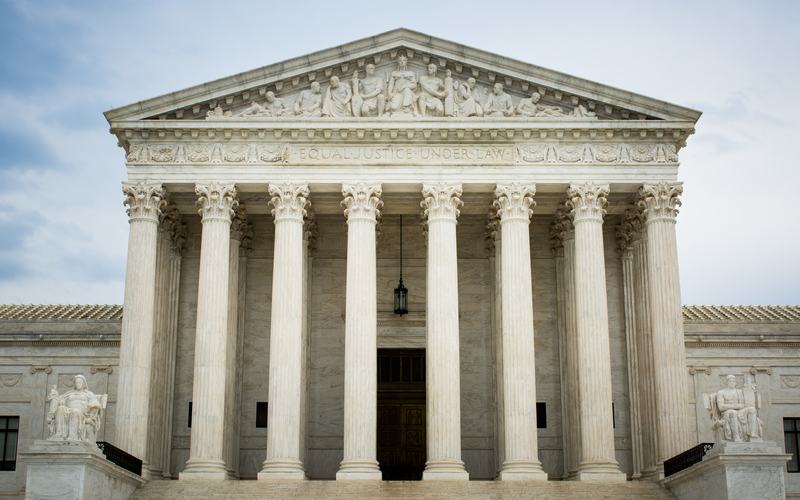
The Supreme Court will hear oral arguments on Wednesday in Trump v. Barbara, a case challenging President Donald Trump's Executive Order 14160 on birthright citizenship. The order, issued on January 20, 2025, the first day of Trump's second term, directs federal agencies to deny citizenship documentation to certain U.S.-born infants whose mothers were unlawfully present or temporarily in the country on visas, unless the father is a U.S. citizen or lawful permanent resident.
The executive order applies prospectively, 30 days after issuance, and does not affect children of lawful permanent residents. It interprets the 14th Amendment's citizenship clause, "all persons born or naturalized in the United States, and subject to the jurisdiction thereof, are citizens," and the codifying statute 8 U.S.C. § 1401(a) as excluding children of undocumented immigrants and nonimmigrants like tourists or students.
Immediate lawsuits followed the order's issuance. Advocacy groups, including the ACLU and CASA, filed challenges within hours. Federal district judges in multiple circuits, including New Hampshire's Joseph Laplante in Barbara v. Trump, issued preliminary injunctions blocking enforcement, ruling the order likely violated the Constitution. In June 2025, the Supreme Court in a related case, Trump v. CASA, ruled 6-3 to limit the scope of nationwide injunctions, prompting narrower class-wide blocks in lower courts. The administration petitioned for certiorari before judgment from the 9th Circuit and district courts in September 2025; the Court granted review on December 5, docketed as 25-365.
The Trump administration argues the order restores the clause's "original meaning," primarily intended to grant citizenship to freed slaves post-Dred Scott v. Sandford (1857), not children of illegal aliens or temporary visitors owing no "direct and immediate allegiance." Solicitor General D. John Sauer cites Slaughter-House Cases (1873) and Elk v. Wilkins (1884), which denied citizenship to a Native American born on a reservation, emphasizing full political jurisdiction. The government contends undocumented immigrants cannot establish domicile and that the practice incentivizes "birth tourism."
Respondents counter that the order contradicts United States v. Wong Kim Ark (1898), affirming citizenship for children of resident Chinese aliens, rooted in common-law jus soli (right of soil) except for diplomats and invading forces. They argue "subject to the jurisdiction" includes all born in U.S. territory owing basic legal obedience, and the 1952 Immigration and Nationality Act codified broad birthright citizenship. Challengers warn of upheaval for millions, including past generations, potentially questioned.
Practical concerns loom large. Critics predict chaos in hospitals processing over 3.6 million annual births, as agencies would require parental immigration proof for passports and Social Security numbers, straining databases with inaccurate records. Justice Brett Kavanaugh questioned the feasibility during prior arguments: "For all the newborns?" Amicus briefs from states, scholars, and lawmakers fill the docket, with supporters arguing it curbs illegal immigration incentives.
A decision is expected by late June or early July 2026, potentially reshaping citizenship for future generations amid divided lower courts.

Comments
No comments yet. Be the first to share your thoughts.