
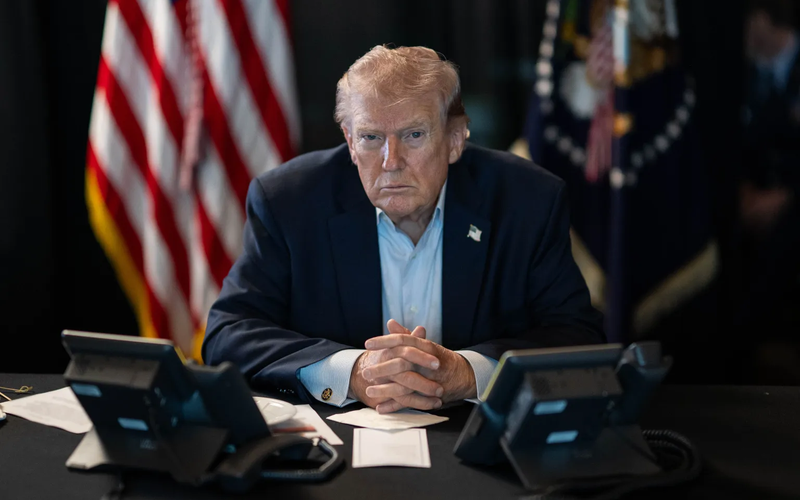
President Donald Trump announced Sunday that the United States would begin a naval blockade of the Strait of Hormuz, a critical global shipping route, and would interdict vessels suspected of paying tolls to Iran for passage.
In a post on Truth Social, Trump said the U.S. Navy would “immediately” begin blocking ships attempting to enter or leave the strait, emphasizing that Iran would not be allowed to charge what he described as illegal transit fees. He also ordered U.S. forces to stop and inspect any vessel in international waters that had paid such tolls, warning that those ships would not be granted safe passage.
The move follows the breakdown of high-level talks between U.S. and Iranian officials earlier in the day. While both sides described portions of the discussions as productive, negotiations ultimately failed to produce an agreement, with U.S. officials citing Iran’s refusal to abandon its nuclear ambitions as a key sticking point.
Vice President JD Vance said after the 21-hour meeting that Washington had sought firm assurances Tehran would not develop nuclear weapons or maintain the capability to rapidly do so. Iranian officials, led by parliament speaker Mohammad Bagher Qalibaf, said their position had been clearly presented and placed responsibility on the United States for failing to reach a deal.
The lack of agreement leaves a two-week ceasefire, currently set to expire on April 22, in doubt. Pakistani mediators have urged both sides to maintain the truce and continue diplomatic efforts, though neither Washington nor Tehran has outlined next steps if the ceasefire lapses.
Iran has long denied pursuing nuclear weapons, maintaining that its program is for civilian purposes. However, analysts say the country’s stockpile of enriched uranium has approached levels that could shorten the timeline for weapons development if further enriched.
The Strait of Hormuz remains a central point of tension in the conflict. Roughly one-fifth of the world’s oil supply passes through the narrow waterway under normal conditions, making any disruption a major concern for global energy markets. The ongoing war, which began Feb. 28, has already affected oil and gas flows and damaged infrastructure across multiple countries in the region.
Since the start of hostilities, more than 3,000 people have been reported killed in Iran, with additional casualties in Lebanon, Israel, and several Gulf states. Fighting has continued in some areas despite the ceasefire, including Israeli strikes in southern Lebanon that local media say have resulted in further deaths.
Diplomatic efforts are also underway elsewhere in the region. Talks between Israeli and Lebanese officials are expected to begin in Washington this week, though protests have emerged in Beirut over the planned negotiations. Israel has continued to push for the disarmament of Hezbollah, a longstanding objective that remains unresolved.
Iranian state media indicated that Tehran remains open to future negotiations, but the latest developments underscore the widening divide between the two sides as the ceasefire deadline approaches.

Comments
No comments yet. Be the first to share your thoughts.