
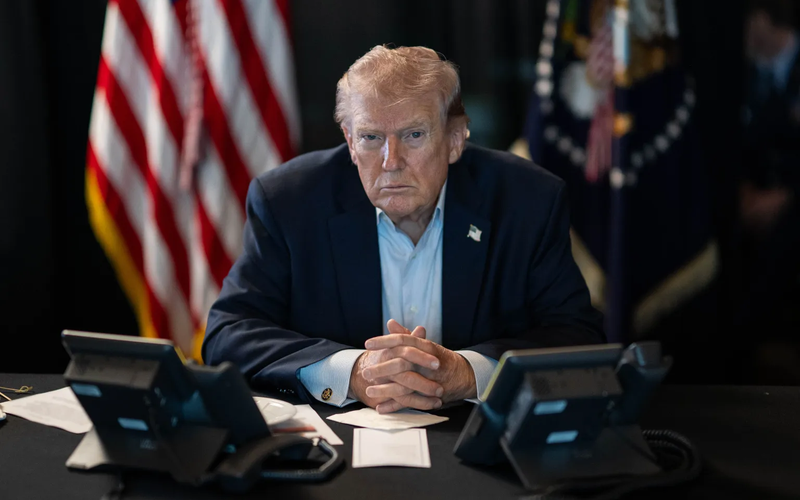
President Donald Trump escalated his rhetoric against Iran on Monday, threatening to destroy the country's power plants, oil wells, Kharg Island, and desalination plants unless a ceasefire deal is reached soon and the Strait of Hormuz is fully reopened.
In a post on Truth Social, Trump stated that the U.S. is in "serious discussions with A NEW, AND MORE REASONABLE, REGIME to end our Military Operations in Iran," claiming great progress has been made. He added, "But, if for any reason [a deal is] not shortly reached... we will conclude our lovely ‘stay’ in Iran by blowing up and completely obliterating all of their Electric Generating Plants, Oil Wells and Kharg Island (and possibly all desalinization plants!), which we have purposefully not yet ‘touched.’"
The threat comes amid a war that began on February 28, 2026, with U.S. strikes on Iranian military positions, including on Kharg Island, a key oil export hub. Iran responded by partially closing the Strait of Hormuz, through which one-fifth of global oil passes, and launching missile and drone attacks on Israel, Gulf states, and U.S. interests. Proxies, including Hezbollah in Lebanon and Houthi rebels in Yemen, have joined the fray, with the Houthis firing at Israel on March 29.
Trump first issued a 48-hour ultimatum on March 21, demanding Iran fully reopen the strait or face strikes on power plants "starting with the biggest one first." He postponed action multiple times, first by five days pending talks, then extending to April 6. On Monday, Iran allowed 20 oil tankers through the strait as a gesture, though full reopening remains uncertain.
Iran has rejected a U.S. 15-point ceasefire proposal as "excessive, unrealistic, and irrational," denying direct negotiations despite Trump's claims of progress via intermediaries like Pakistan. Iranian officials, including parliament speaker Mohammad Bagher Qalibaf, warned that targeting their infrastructure would prompt retaliation against regional energy and water facilities, including desalination plants vital to Gulf states.
Casualties have mounted, with over 1,900 dead in Iran, 19 in Israel, including six soldiers in Lebanon, over 1,200 in Lebanon, and 13 U.S. service members killed. Strikes have hit civilian sites, including a Kuwaiti water plant, killing one and wounding 10, and Israel's Haifa oil refinery.
The threats have spiked oil prices, with Brent crude above $115 per barrel, up 60% since the war began, raising fears of global energy shortages and inflation. Experts warn that attacks on desalination plants could cause humanitarian crises by disrupting water supplies for millions.
Amnesty International called Trump's warnings a potential war crime under international law, while Gulf allies like Saudi Arabia and the UAE intercepted Iranian missiles and sought guarantees against further attacks. The U.S. has deployed thousands more troops to the region as talks continue.

Comments
No comments yet. Be the first to share your thoughts.