
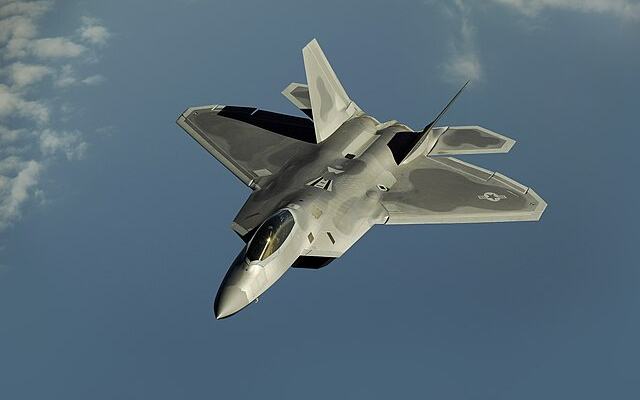
A dozen U.S. Air Force F-22 Raptor stealth fighter jets landed Tuesday at Ovda Air Base in southern Israel, marking a rare deployment amid escalating tensions with Iran. The advanced aircraft departed from RAF Lakenheath in Britain earlier that day, supported by tanker planes, with flight tracking data and plane spotter videos confirming their path to Israel.
U.S. officials, speaking anonymously, confirmed the move as part of a massive military buildup in the Middle East, the largest since the 2003 Iraq invasion. This includes two aircraft carrier strike groups, USS Gerald R. Ford and USS Abraham Lincoln, over 300 military aircraft across the region, and additional jets stationed in Jordan. The deployment comes two days before U.S.-Iran nuclear talks resume Thursday in Geneva.
President Donald Trump emphasized diplomacy during his State of the Union address Tuesday, stating, “My preference is to solve this problem through diplomacy. But one thing is certain, I will never allow the world’s No. 1 sponsor of terror... to have a nuclear weapon.” White House Press Secretary Karoline Leavitt reiterated that Trump’s first option is diplomacy but affirmed readiness to use military force if necessary. Retired Lt. Gen. David A. Deptula described the F-22 move as signaling “preparation for a more aggressive stance toward Iran and potential cooperation with Israel in an attack.”
Israeli officials view a U.S. strike on Iran as increasingly likely unless Tehran concedes on uranium enrichment demands, with one senior figure telling Channel 12 that an agreement would contradict Iran’s regime spirit. IDF Chief of Staff Eyal Zamir recently briefed U.S. Joint Chiefs head Gen. Dan Caine on military options.
The F-22 Raptor, the U.S. military’s premier air-superiority fighter, excels in speed, maneuverability, and stealth for air-to-air combat and ground strikes. Unlike the F-35, which Israel operates, the F-22 has never been exported due to U.S. law. Stationing them operationally at an Israeli base, rather than for training, is highly unusual.
Iran has responded with military drills by the Islamic Revolutionary Guard Corps on its southern coast, simulating attacks on ships and shore targets. Deputy Foreign Minister Majid Takht-Ravanchi warned that any U.S. aggression would prompt a response per Iran’s defense plans. Iranian Foreign Minister Abbas Araghchi stated a deal is possible if diplomacy prevails, submitting a counterproposal approved by Supreme Leader Ayatollah Ali Khamenei.
The core dispute remains U.S. insistence that Iran halt all enrichment versus Tehran’s claim to peaceful nuclear rights.

Comments
No comments yet. Be the first to share your thoughts.