
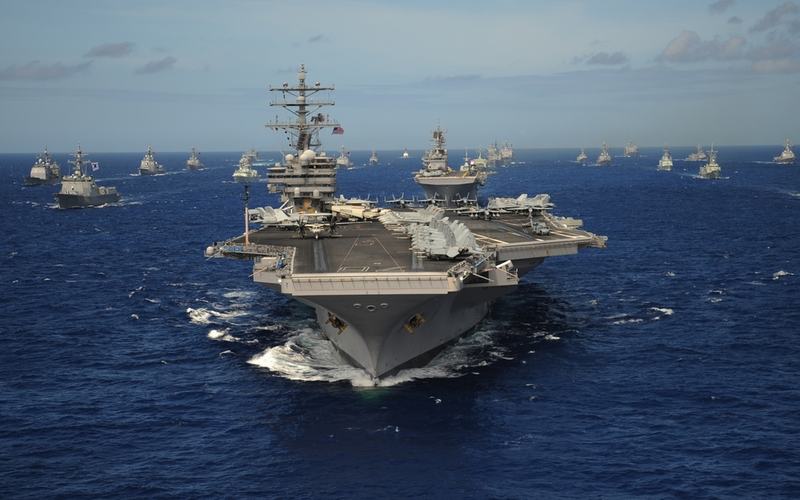
The United States has significantly increased its military presence across the Middle East, assembling major naval and air assets as the Trump administration intensifies pressure on Iran.
At the center of the buildup are two aircraft carrier strike groups led by the USS Gerald R. Ford and the USS Abraham Lincoln. The Ford, the Navy’s newest and largest aircraft carrier, was recently observed off the coast of Morocco en route toward the Strait of Gibraltar. Its strike group includes guided missile destroyers and a full combat air wing featuring F/A-18 Super Hornets, EA-18G Growlers, E-2D Hawkeyes, and Seahawk helicopters.
The Lincoln strike group, which arrived in the Arabian Sea after transiting from the South China Sea, is reportedly positioned roughly 700 kilometers from Iran. The carrier fields approximately 90 aircraft, including Marine Corps F-35C stealth fighters, along with Super Hornets and electronic warfare aircraft capable of sustained combat operations.
Additional U.S. warships are operating across key waterways, including the Mediterranean Sea, Red Sea, Arabian Sea, and Persian Gulf. These include multiple Arleigh Burke-class guided missile destroyers and several Independence-class littoral combat ships, expanding missile defense and strike capabilities throughout the region.
Airpower deployments have also accelerated. Numerous American aircraft have staged through bases in the United Kingdom, Germany, Italy, and Greece. Confirmed movements include F-22 fighters, F-16s, F-35s, E-3 Sentry AWACS aircraft, KC-135 refueling tankers, and RC-135 Rivet Joint surveillance planes.
In the Middle East, over 50 F-15 and EA-18 fighter jets reportedly arrived at Muwaffaq Salti Air Base in Jordan. Strategic airlift flights involving C-17 and C-5M aircraft have transported personnel and equipment into the region in sustained waves since mid-January.
The surge comes as a second round of nuclear negotiations concluded this week and were described as “constructive,” even as military positioning continues to expand. The scale and distribution of assets signal a readiness posture that could support deterrence, rapid escalation, or extended operations if diplomatic efforts fail.

Comments
No comments yet. Be the first to share your thoughts.