
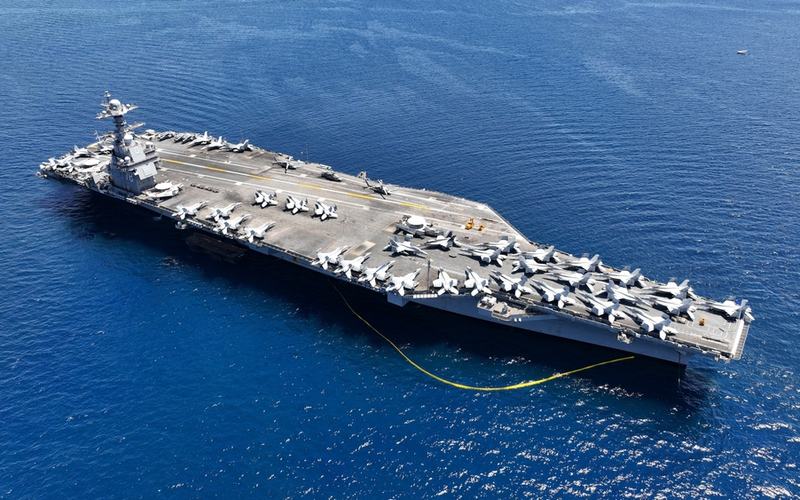
The United States is sending its newest and largest aircraft carrier, the USS Gerald R. Ford, to the Middle East, joining the USS Abraham Lincoln and its accompanying warships in a bolstered naval presence as tensions with Iran intensify.
Officials say the Ford, which has been operating from the Caribbean after earlier deployments in Europe and the Mediterranean, will transit the Atlantic to support increased pressure on Tehran amid stalled indirect negotiations over its nuclear program.
Its reassignment marks the first time in recent months that two U.S. carrier strike groups will be positioned in the U.S. Central Command area, significantly increasing American military capability in the region.
The USS Abraham Lincoln and three guided‑missile destroyers arrived in the Middle East more than two weeks ago as part of an earlier buildup. Bringing the Ford to the region expands that force, which may include additional air and surveillance assets.
The Ford deployment began in late June 2025. Officials say the extended mission, expected to last into April or May, pushes the carrier past its usual deployment duration and places added strain on its crew.
President Trump has publicly warned Iran that failure to reach an agreement on its nuclear program could bring “very traumatic” consequences, even as diplomatic efforts continue. The increased naval presence underscores Washington’s readiness to impose military pressure if talks falter.
Israeli officials have also urged the U.S. to press Iran to limit its ballistic missile development and curtail support for militant groups as part of any negotiated deal, amplifying regional expectations that the strengthened U.S. posture will influence Tehran’s strategic calculations.
The redeployment reflects a shift from earlier strategic focus on the Western Hemisphere—as seen in recent operations near Venezuela back toward the Middle East, highlighting the administration’s prioritization of confronting persistent threats from Iran.
Pentagon officials have not specified how long the Ford will remain in the region, but analysts and military sources say the dual‑carrier presence sends a clear signal of U.S. resolve at a critical juncture in negotiations and regional security dynamics.

Comments
No comments yet. Be the first to share your thoughts.