
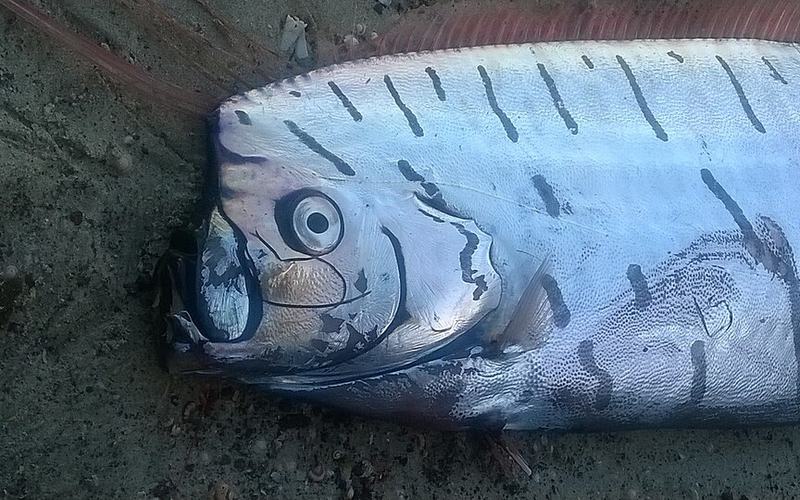
A rare 16-foot oarfish, widely known as the “Doomsday fish,” washed ashore on Tuesday in Mejillones, northern Chile, drawing attention on social media because of its unusual, serpent-like appearance and long-standing associations with natural disasters.
The fish has deep roots in Japanese folklore, where it is known as Ryugu no tsukai, meaning “Messenger from the Sea God’s Palace.” According to traditional beliefs, oarfish surfacing in shallow waters may signal an impending catastrophe. The legend is also associated with Namazu, a giant mythological catfish believed to cause earthquakes by thrashing beneath the earth.
The folklore gained renewed attention following Japan’s devastating 2011 Tohoku earthquake and tsunami. In the months before the disaster, approximately a dozen oarfish reportedly washed ashore, fueling speculation about a possible connection between the fish and seismic activity.
Oarfish can grow between 26 and 50 feet long and move through the water with a distinctive, ribbon-like motion. Their unusual appearance may also have contributed to historical accounts of enormous sea serpents. A log from March 1860 described a 16-foot creature washing ashore on a Bermuda beach, frightening local residents. Sailors told stories of similar beasts with enormous, razor-sharp teeth that could destroy ships.
Scientific research has found no reliable evidence that oarfish strandings predict earthquakes. In 2019, researchers at Tokai University examined 336 deep-sea fish strandings in Japan over several decades and compared them with earthquakes measuring magnitude 6.0 or greater.
The study found no statistically significant relationship between the strandings and earthquakes. Researchers also examined whether the fish had appeared within 30 days before an earthquake and approximately 60 miles of its epicenter. Only one case among the hundreds examined met those conditions.
The researchers described the perceived connection as an example of “illusory correlation,” a psychological phenomenon in which people associate unrelated events because memorable coincidences stand out in their minds.
Scientists explain that oarfish typically inhabit depths of approximately 650 to 3,300 feet. Despite their size, they are not strong swimmers and can struggle when conditions force them out of their usual environment.
Strong ocean currents, upwelling and severe storms may bring the fish closer to the surface, where they can become disoriented and unable to navigate rough waters. Injuries or other conditions that impair their ability to swim may also contribute to strandings.
Rather than signaling an impending catastrophe, scientists consider oarfish found near shore to be unusual occurrences that can have natural explanations. Despite the enduring folklore, research has not established a connection between these deep-sea creatures and impending earthquakes or other natural disasters.

Comments
No comments yet. Be the first to share your thoughts.