
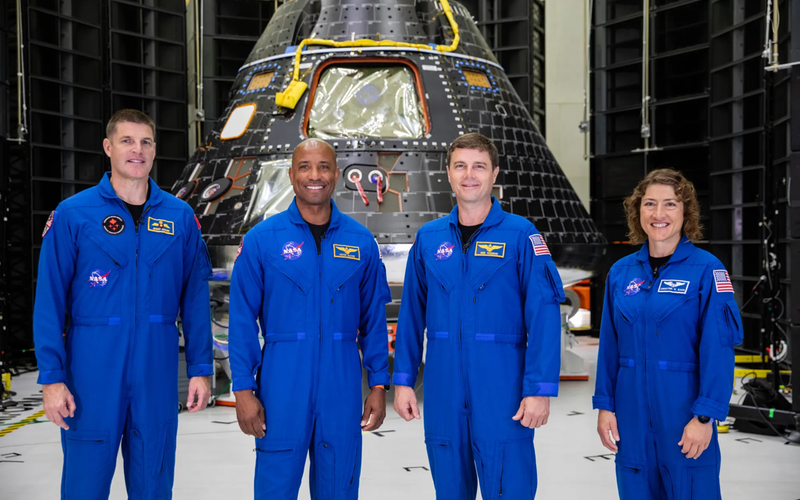
NASA's Artemis II astronauts spent their final full day in space Thursday, stowing gear aboard the Orion spacecraft as they approached Earth ahead of Friday's scheduled splashdown in the Pacific Ocean.
The crew, Commander Reid Wiseman, Pilot Victor Glover, Mission Specialist Christina Koch, and Mission Specialist Jeremy Hansen of the Canadian Space Agency, launched atop the Space Launch System rocket from Kennedy Space Center on April 1 at 6:35 p.m. EDT. This marked the first human flight beyond low Earth orbit since Apollo 17 in 1972 and tested Orion's systems for future lunar landings.
After checkouts in high Earth orbit, the spacecraft performed translunar injection on flight day 2, heading toward the Moon on a free-return trajectory. On April 6, Orion reached closest approach at 4,067 miles, allowing the crew to observe the lunar far side and capture images. The mission broke records, traveling 252,756 miles from Earth, farther than any humans before.
Glover became the first person of color beyond low Earth orbit, Koch the first woman, and Hansen the first non-American. The crew deployed four CubeSats for radiation and space weather studies, conducted health experiments, and tested optical communications.
Now in the return phase, Orion completed correction burns, including one on April 7 lasting 15 seconds. Flight Day 9 updates showed the spacecraft 147,337 miles from Earth, with the crew awakened to music before final tests. NASA held daily briefings, confirming nominal status despite pre-launch delays from heat shield fixes and leaks.
Splashdown is set for 8:07 p.m. EDT Friday off San Diego, recovered by the USS John P. Murtha. Reentry speeds will hit about 24,000 mph under parachutes. Live coverage begins hours earlier on NASA+ and YouTube.
The mission paves the way for Artemis III's planned lunar landing in 2027.

Comments
No comments yet. Be the first to share your thoughts.