
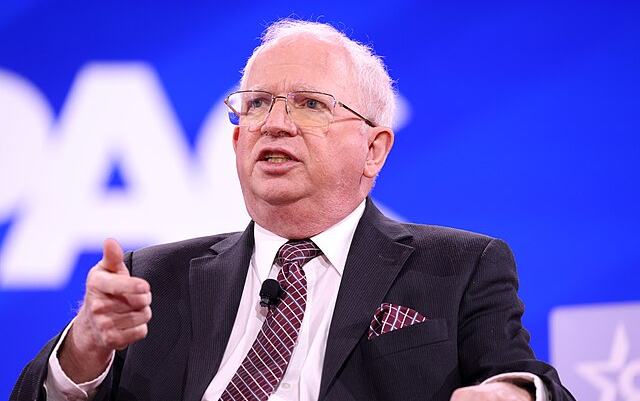
The California Supreme Court disbarred attorney John Charles Eastman on April 15, 2026, concluding a multi-year disciplinary process over his role in helping President Trump contest the results of the 2020 presidential election.
Eastman, a former dean of Chapman University School of Law and advisor to then-President Donald Trump, lost his license after the court denied his petitions for review. The decision followed recommendations from lower State Bar Court panels. In March 2024, the State Bar Court Hearing Department found him culpable on 10 of 11 charges involving egregious and deceitful conduct. The Review Department affirmed those findings in July 2025.
The violations stemmed from Eastman's actions after the November 2020 election. He drafted memos arguing that Vice President Mike Pence had the authority to reject electoral votes from swing states that Trump disputed, such as Arizona, Georgia, Michigan, Pennsylvania, and Wisconsin. Eastman also helped promote a strategy involving alternate "fake electors" loyal to Trump in those states to create uncertainty during the January 6, 2021, congressional certification. He spoke at a rally near the White House that day, repeating claims of election fraud, shortly before the Capitol riot.
State Bar officials described Eastman's efforts as lacking factual or legal support and violating ethics rules against misleading courts and making false public statements. "The Court’s order underscores that Mr. Eastman’s misconduct was incompatible with the standards of integrity required of every California attorney," said State Bar Chief Trial Counsel George Cardona.
The Supreme Court ordered Eastman stricken from the roll of attorneys and to pay $5,000 to the State Bar. His license had been under interim suspension since early 2023 while appeals proceeded.
Eastman has maintained that his advice constituted protected legal advocacy and zealous representation of his client. His attorney, Randall Miller, announced plans to appeal to the U.S. Supreme Court, arguing the disenfranchisement infringes on First Amendment rights.
The case marks a significant accountability measure for figures involved in the 2020 election challenges. Eastman represented Trump in a failed U.S. Supreme Court bid to invalidate votes in battleground states. Pence rejected the theory, stating he lacked unilateral power under the Constitution.
Cardona emphasized the ruling's broader message: "Attorneys must act with honesty and uphold the rule of law, regardless of the client they represent or the context in which that representation occurs."
Eastman's disbarment applies only in California, where he was admitted to practice in 1993. He faces separate proceedings in other jurisdictions and criminal charges in Georgia, though some have been resolved.

Comments
No comments yet. Be the first to share your thoughts.