
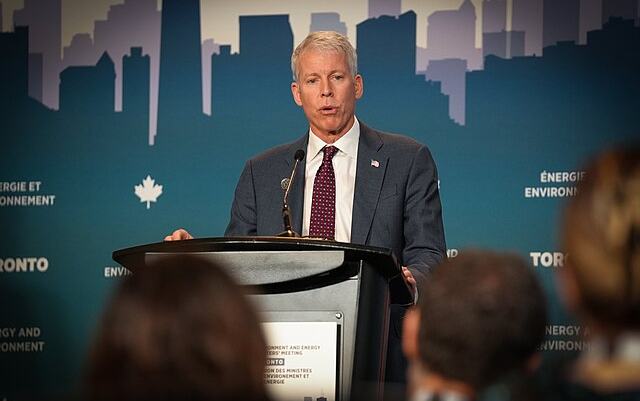
Energy Secretary Chris Wright predicted Sunday that the ongoing U.S. conflict with Iran will conclude within the next few weeks. Speaking on ABC News' "This Week" and NBC's "Meet the Press," Wright said the war, now in its third week, represents a short-term disruption to global energy flows.
"I think that this conflict will certainly come to an end in the next few weeks," Wright told ABC's Martha Raddatz. "Could be sooner than that, but the conflict will come to an end in the next few weeks." He added on NBC that Americans "will feel it for a few more weeks," referring to elevated gas prices, but that the end result would remove Iran's threat to global energy supplies.
The war began on February 28, 2026, when the U.S. and Israel launched joint airstrikes under Operations Epic Fury and Roaring Lion, targeting Iranian nuclear sites, military bases, and leadership, including Supreme Leader Ali Khamenei. Iran retaliated with missile and drone barrages on U.S. bases, Israeli cities, and Gulf states, while mining and impeding the Strait of Hormuz, through which about 20% of global seaborne oil passes.
The disruptions have driven oil prices above $100 per barrel and national average gas prices to $3.69-$3.70 per gallon, up from $2.94 before the conflict. Wright noted that reopening the strait is a key objective, with U.S. forces having struck Iran's Kharg Island oil export hub and distant projection capabilities first.
While optimistic, Wright cautioned there are "no guarantees in war" on the exact timeline or price drops, though he said there is a "very good chance" gas could fall below $3 per gallon by summer. President Donald Trump has suggested the offensive could take four to five weeks or end when he "feels it in [his] bones."
Casualties include at least 15 U.S. servicemembers killed, thousands in Iran, and hundreds across Israel, Lebanon, and Gulf states. Iran's missile launches have dropped by over 90%, and U.S.-Israeli forces claim control of its airspace. Wright emphasized the conflict's brevity compared to longer wars, predicting a post-war world with more abundant and affordable energy.

Comments
No comments yet. Be the first to share your thoughts.