
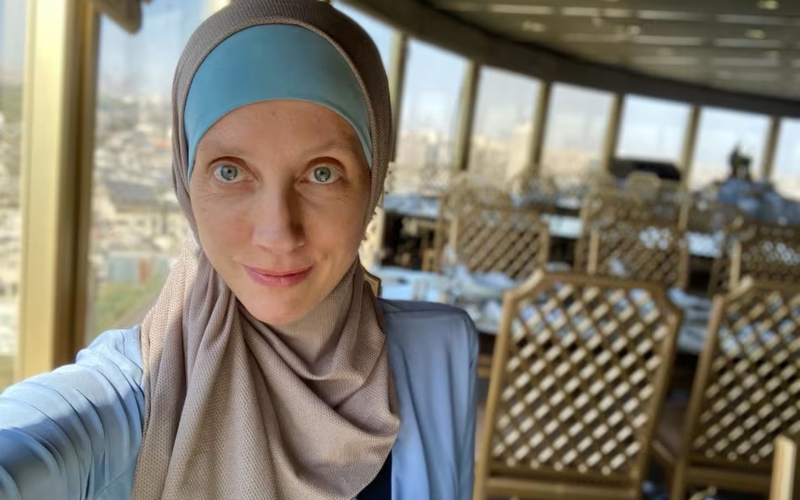
An Iran-backed Iraqi militia released American freelance journalist Shelly Kittleson on Tuesday after holding her captive for a week in Baghdad.
Kittleson, 49, was abducted on March 31 from a street corner in central Baghdad by armed men who forced her into a vehicle. Iraqi security forces pursued the kidnappers, leading to a crash near al-Haswa in Babil province, southwest of Baghdad. Authorities arrested one suspect linked to the militia's 45th Brigade in the Popular Mobilization Forces.
Kataib Hezbollah, a powerful group with ties to Iran's Quds Force, took responsibility through a statement from security official Abu Mujahid al-Assaf. The militia announced the release "in recognition of the national stances of the outgoing prime minister," referring to Mohammed Shia al-Sudani, adding that Kittleson must "leave the country immediately" and that "this initiative will not be repeated in the future."
Two Iraqi security officials confirmed the exchange involved freeing several detained Kataib Hezbollah members, many linked to attacks on a U.S. base in Syria. Negotiations involved Iraqi officials from the prime minister's office and the pro-Iran Coordination Framework, with U.S. State Department and FBI support, though militia leaders proved difficult to reach as they operated underground.
U.S. officials had warned Kittleson multiple times of specific threats from Iran-backed paramilitaries before the kidnapping. Her name appeared on a list held by Kataib Hezbollah targeting female journalists for kidnapping or assassination, according to her friend and emergency contact, CNN analyst Alex Plitsas.
A veteran correspondent based in Rome, Kittleson has covered conflicts in Iraq, Syria, and Afghanistan for over a decade. Her clients include Al-Monitor, New Lines Magazine, Politico, Al-Majalla, and Il Foglio. She entered Iraq shortly before the abduction despite the warnings and worked without the resources of major news organizations.
The incident occurred amid heightened tensions, with Iran-aligned militias conducting attacks on U.S. targets in Iraq and the region since the escalation of the U.S.-Israeli conflict involving Iran. Kataib Hezbollah previously held Russian-Israeli researcher Elizabeth Tsurkov for over two years after her 2023 abduction in Baghdad before her release in September 2025.
The U.S. Embassy in Baghdad and the State Department had no immediate comment on the release. Iraqi Prime Minister al-Sudani had ordered security forces to pursue those responsible for abducting foreigners. No details emerged on Kittleson's condition upon release, though she was held in Baghdad until her freedom in the afternoon.

Comments
No comments yet. Be the first to share your thoughts.