
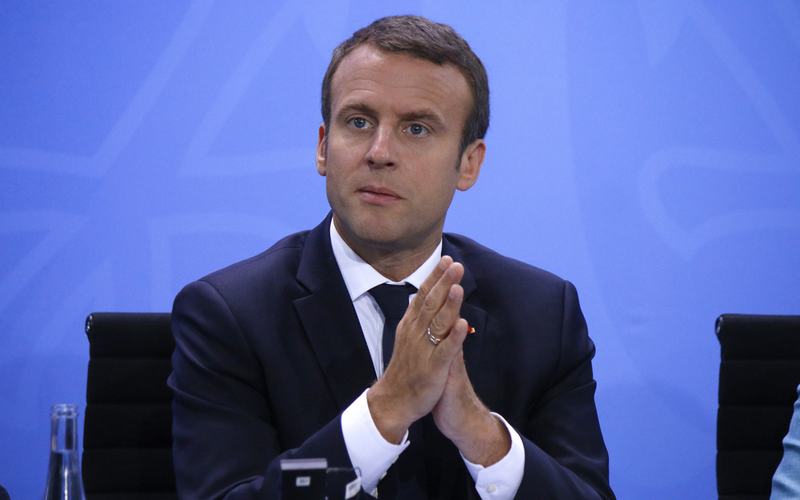
French President Emmanuel Macron called on medium-sized countries on Friday to form a coalition and resist becoming vassals of the United States and China. Speaking at Yonsei University in Seoul, South Korea, during an Asia tour, Macron said, "Our objective is not to be the vassals of two hegemonic powers." He added, "We don’t want to depend on the dominance... of China, or... too much exposed to the unpredictability of the US."
Macron proposed collaboration among nations like Australia, Brazil, Canada, India, Japan, South Korea, and European countries on artificial intelligence, space, energy, nuclear power, defense, and security. He framed this as a push for independence amid global tensions, including high energy costs from Iran's blockade of the Strait of Hormuz.
The remarks come amid escalating friction with U.S. President Donald Trump over the ongoing U.S.-Israel war against Iran, now in its second month. Iran shut the Strait, through which one-fifth of global oil flows, in retaliation for strikes, spiking prices and inflation worldwide. Trump has accused NATO allies, including France and South Korea, of insufficient support. He criticized France for denying overflight rights to U.S. planes bound for Israel, calling it "VERY UNHELPFUL" and warning, "The U.S.A. will REMEMBER!!!" Trump also labeled NATO a "paper tiger" and hinted at withdrawal while urging allies to secure the strait themselves or "get your own oil."
Macron pushed back, calling military force to reopen the strait "unrealistic" and advocating deconfliction with Iran and post-bombing escorts for ships. He criticized Trump's shifting positions, saying, "You have to be serious. When you want to be serious, you don’t go around saying the opposite every day of what you just said the day before. And perhaps you shouldn’t talk every day."
On NATO, Macron warned that daily public doubts about U.S. commitment erode the alliance's trust. "Alliances like NATO are valuable because of the things we don't say, because of the trust behind it," he said. "If you create doubts every day about your commitment, you empty [NATO] of its substance."
The personal feud sharpened when Trump mocked Macron's marriage at a White House event, claiming his wife treats him "extremely badly." Macron dismissed it as unworthy of response.
Macron's stance aligns with France's post-World War II tradition of balancing superpowers, echoed in his 2023 China visit, where he rejected EU vassalage to the U.S. He plans to advance this at France's G-7 summit in June. European leaders, even from pro-U.S. nations like Britain, have resisted Trump's Iran demands, prioritizing a ceasefire.

Comments
No comments yet. Be the first to share your thoughts.