
The latest migration numbers tell a story union leaders would rather ignore: Americans are leaving states where organized labor holds enormous political influence and moving to states where workers have greater freedom and economic opportunity.
Consider the migration data. According to U.S. Census estimates, states such as Texas, North Carolina, and South Carolina are seeing some of the largest inflows of domestic migrants. In 2024 alone, Texas gained more than 85,000 residents through domestic migration, while South Carolina gained over 68,000. Meanwhile, states such as California, New York, and Illinois experienced the largest losses, with California alone losing nearly 240,000 residents to other states.
This trend is part of a broader national shift. Over the past several years, millions of Americans have moved toward the South and Mountain West, regions experiencing the fastest population growth and strongest migration gains.
These states share several characteristics: lower costs of living, stronger job growth—and, importantly, greater workplace freedom.
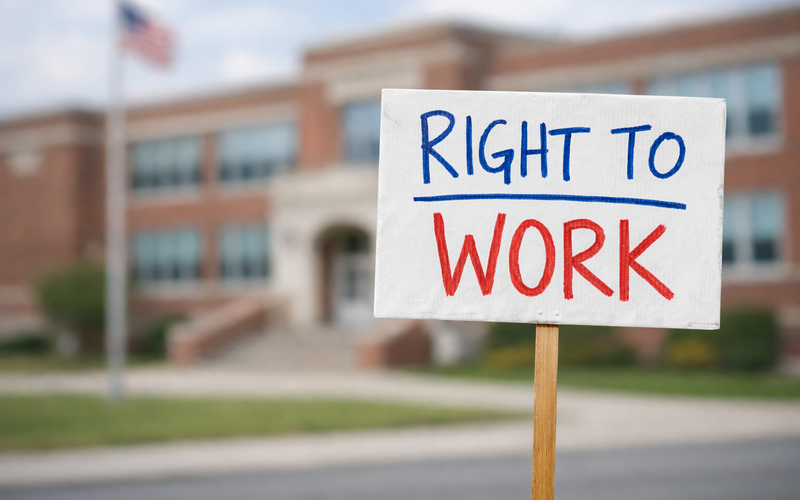
Most of the states gaining residents are right-to-work states, where workers cannot be forced to join a union or pay union dues as a condition of employment.
The contrast with heavily unionized states is striking.
Across the United States today, unions represent a relatively small share of the workforce. According to the U.S. Bureau of Labor Statistics, the overall union membership rate was 9.9 percent in 2024, less than half the rate recorded in the early 1980s.
In the private sector, union membership is even lower—just 5.9 percent of workers.
Yet despite representing a shrinking share of workers, organized labor remains one of the most powerful political forces in American politics.
Union organizations spend hundreds of millions of dollars each election cycle on political campaigns, lobbying efforts, and ballot initiatives designed to expand government spending and protect union power. Much of that money ultimately comes from workers’ dues.
This dynamic is especially pronounced in the public sector. While fewer than 6 percent of private-sector workers belong to unions, more than 32 percent of public-sector employees are union members, giving unions enormous influence over government employment policy and public spending.
That political influence can shape entire state economies.
Union-backed politicians often reward organized labor with favorable legislation, generous public-sector contracts, and regulatory systems that make it harder for businesses to grow and entrepreneurs to launch new companies.
The costs are real.
Taxpayers face higher taxes to fund expanding public payrolls. Businesses confront rigid labor rules and rising regulatory burdens. Families see fewer job opportunities and higher costs of living.
Over time, this system creates a self-reinforcing cycle: union political spending helps elect politicians who expand union power, which in turn fuels more political spending.
But American workers are increasingly pushing back.
In 2018, the Supreme Court issued its landmark decision in Janus v. AFSCME, ruling that public-sector employees cannot be forced to pay union fees as a condition of employment. The Court recognized that compelling workers to fund union activity—particularly political activity—raises serious First Amendment concerns.
That decision affirmed a simple but powerful principle: workers deserve the freedom to decide for themselves whether a union represents their interests.
For many Americans, exercising that freedom also means choosing where to live.
The migration numbers show millions of Americans moving toward states where economic growth is stronger, opportunity is expanding, and workers have greater freedom in the workplace.
These states are not perfect. But they are generally less dominated by union political spending and less captive to union-driven agendas.
Workers have more choice. Employers have more flexibility. Entrepreneurs face fewer barriers.
And growth tends to follow.
Union leaders often claim they speak for working people. But when unions devote enormous resources to political influence—frequently funded by workers’ dues—they often advance the interests of union executives and allied politicians rather than the individual workers those unions claim to represent.
The migration data tells the story clearly.
Americans are voting with their feet.
They are choosing states where opportunity is expanding, where economic policy encourages growth, and where workers have the freedom to decide for themselves whether union membership is right for them.
That is not an accident.
It is a reminder that when workers have real choice, they use it.

Comments
No comments yet. Be the first to share your thoughts.