
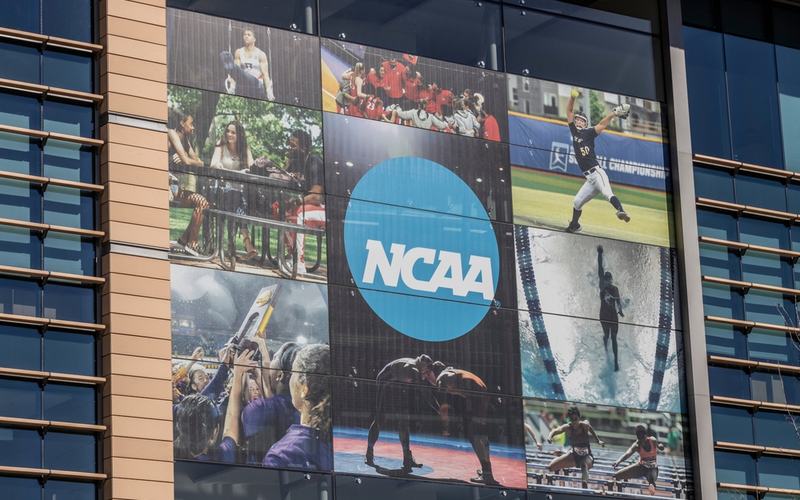
NCAA President Charlie Baker is pressing Congress to establish nationwide rules governing college athletics, warning that unrestricted transfers and repeated legal challenges to eligibility requirements are undermining academic outcomes and competitive fairness.
In a letter to lawmakers Thursday, Baker urged the House to pass the Protect College Sports Act, which the Senate approved last month. He argued that federal legislation is necessary to restore stability to college sports and establish enforceable protections for student-athletes.
Baker pointed to an NCAA-commissioned review showing that graduation rates were lower among athletes who transferred schools, particularly those who transferred multiple times. According to the findings cited in his letter, 88% of student-athletes who never transferred graduated on time, compared with 81% of those who transferred once.
Among athletes who transferred multiple times, the on-time graduation rate fell to 71%, meaning nearly three in 10 did not graduate on schedule.
“The court-imposed unlimited transfer policy is leading to worse academic outcomes for student-athletes who transfer multiple times,” Baker warned.
The NCAA president also raised concerns about the growing number of lawsuits challenging college sports eligibility rules. He said the legal disputes are creating uncertainty for athletic programs and could prevent high school seniors from securing opportunities to compete at the collegiate level.
“In just the last few months, approximately 200 lawsuits have challenged basic eligibility rules, in some cases allowing former professionals to compete against actual college students ― an outcome that not only undermines the spirit of fair competition but also robs graduating high school seniors of their chance to be recruited and compete in college sports,” Baker said.
The Protect College Sports Act would establish national standards for college athletics, including rules governing name, image and likeness (NIL) compensation and restrictions on athlete transfers. Supporters argue that a federal framework would reduce conflicting rules and legal disputes affecting colleges and athletes across the country.
The legislation passed the Senate in September with bipartisan support, but its path through the House remains uncertain. Lawmakers are expected to consider the measure after the November midterm elections.
The bill faces opposition from civil rights organizations, including the Congressional Black Caucus and the NAACP. Critics argue that the legislation could give the NCAA and major athletic programs excessive authority while disproportionately affecting minority athletes.
Opponents also contend that tighter transfer restrictions could limit athletes' freedom to change schools, compete, and earn money from their athletic performance.
Baker maintains that federal intervention is necessary to address the instability created by the current system. He said the legislation would “provide the foundation necessary to ensure fairness in college sports and deliver unprecedented, enforceable protections directly to student-athletes.”
With Senate approval already secured, the House debate will center on whether nationwide eligibility and transfer rules can address the NCAA's concerns about academic outcomes, lawsuits and competitive fairness while preserving athletes' rights and financial opportunities.

Comments
No comments yet. Be the first to share your thoughts.