
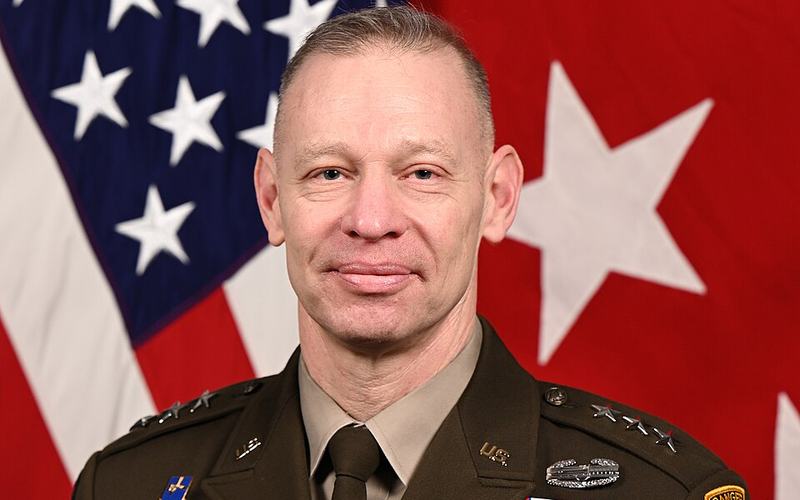
The Pentagon has removed Army Lt. Gen. Brett Sylvia, a senior military strategist responsible for coordinating war plans and policy recommendations for the Joint Chiefs of Staff, as President Donald Trump weighs whether to resume major combat operations against Iran, according to a report published Wednesday by The Atlantic.
Sylvia directed the Joint Staff's J5 directorate, which plays a central role in developing military strategy, long-term operational plans and policy recommendations for senior defense officials and the White House. Pentagon officials told The Atlantic that War Secretary Pete Hegseth had lost confidence in Sylvia and that the general had a difficult working relationship with Elbridge Colby, the Pentagon's senior civilian policy official. No public explanation for Sylvia's departure has been provided, and the military has not announced a replacement.
The timing of the removal has raised questions about the Pentagon's leadership as the administration evaluates potential military action against Iran. A former Joint Chiefs official told The Atlantic that the J5 position is particularly important during a possible escalation, describing the director as a critical link between military forces, department policy and the White House.
"Now is not the time when you'd want to lose the J5," the former official said.
The Joint Chiefs of Staff acknowledged Sylvia's departure in a statement thanking him and his family for more than three decades of military service, but offered no details about the circumstances surrounding his removal.
"The Chairman, the Joint Staff, and the Joint Force extend our deepest gratitude to Lt. Gen. Brett Sylvia and his family for their 32 years of distinguished service to our nation," a spokesperson said. "We wish him and his family the best as they graduate to new opportunities and the next chapters of their lives."
Sylvia is the second director of the Joint Staff's J5 directorate reportedly pushed out within the past year. His predecessor, Army Lt. Gen. Joseph McGee, was also forced into retirement, according to The Atlantic. The successive departures have drawn attention to changes in the Pentagon's senior planning leadership at a time when the United States faces major military and strategic challenges.
Trump is weighing options for renewed strikes against Iran following a period of reduced fighting. U.S. Central Command has prepared several possible approaches, including limited attacks against Iranian nuclear facilities and a broader military campaign intended to increase economic pressure on Tehran, The Atlantic reported. Trump has not made a final decision, and the report said new strikes were considered unlikely before next week's midterm elections.
The confrontation with Iran, which began in February, has left American and Iranian forces facing off around the Strait of Hormuz, one of the world's most important energy shipping routes. Iran has effectively taken control of the waterway, while Washington has imposed a blockade targeting Iranian shipping. Any renewed military campaign could have significant implications for regional security, international energy markets and the broader conflict.
Sylvia's departure is part of a wider turnover among senior military leaders since Hegseth took office. At least 26 generals and admirals have left their positions or been removed, according to The Atlantic. The changes have affected leadership across the Army and other parts of the armed forces, prompting questions about the experience and continuity available to senior defense officials during active military operations.
Among the most prominent departures was Army Chief of Staff Gen. Randy George, who was forced out during the U.S. military campaign against Iran. Other officers who left their posts included Gen. David Hodne, who led the Army's Transformation and Training Command, and Maj. Gen. William Green Jr., who headed the Army Chaplain Corps.
Gen. Chris "C.D." Donahue also stepped down in June as commander of U.S. Army forces in Europe and Africa following disagreements with Hegseth, The Atlantic reported.
The reported reasons for individual departures have varied. Officials cited by the publication described concerns within the Pentagon about officers' previous involvement in diversity initiatives, their associations with former Joint Chiefs Chairman Mark Milley and suspicions about unauthorized disclosures to news organizations. The report did not establish that every departing officer was removed for the same reason.
Hegseth has publicly signaled his intention to reshape the military's senior ranks. During an address in September, he said approximately 10% of the military's generals and admirals had been removed and announced plans to eliminate another 10% of senior officer positions. The administration has emphasized changes to military leadership and its priorities, while the ongoing departures have drawn scrutiny over their timing and potential effects on military planning.
Sylvia brought extensive operational experience to the Joint Staff. A 1994 graduate of the U.S. Military Academy at West Point, he previously commanded the 101st Airborne Division at Fort Campbell, Kentucky, and deployed multiple times to Iraq and Afghanistan. His decorations included six Bronze Star Medals, one awarded for valor, and a Purple Heart.
His removal leaves a key military planning position vacant as the Trump administration weighs its options in the confrontation with Iran. With the possibility of renewed strikes still under consideration, the leadership changes place additional attention on how the Pentagon is organizing its senior ranks and coordinating military strategy with the White House.

Comments
No comments yet. Be the first to share your thoughts.