
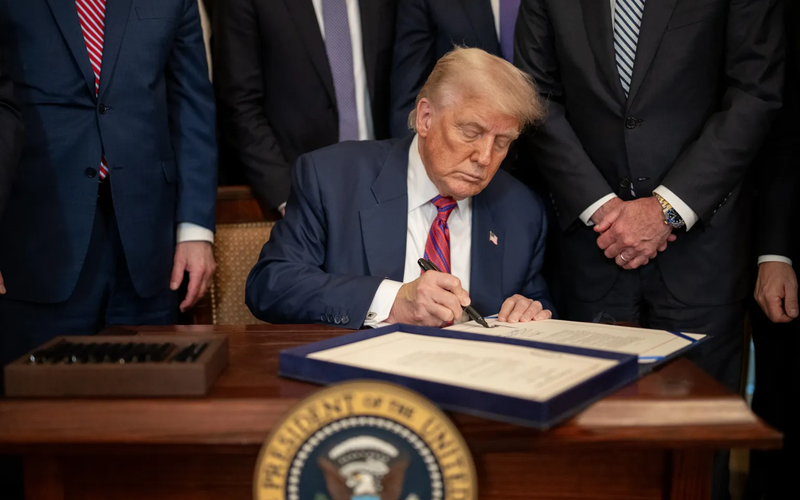
President Donald Trump signed an executive order on Saturday morning directing federal agencies to expedite research and access to psychedelic drugs for mental health treatments, with a particular focus on veterans suffering from post-traumatic stress disorder and traumatic brain injuries.
The order, signed in the Oval Office, instructs the Food and Drug Administration and Department of Health and Human Services to clear bureaucratic hurdles, improve data sharing with the Department of Veterans Affairs, and issue national priority vouchers for three psychedelics to shorten review times from months to weeks. It also allocates $50 million in federal funding for psychedelic research and opens a pathway for ibogaine use under the FDA's Right to Try program for desperately ill patients.
Trump emphasized the potential benefits for veterans during the signing ceremony, surrounded by Health and Human Services Secretary Robert F. Kennedy Jr., FDA Commissioner Marty Makary, podcaster Joe Rogan, former Navy SEAL Marcus Luttrell, and Americans for Ibogaine CEO W. Bryan Hubbard. "Everybody is so strongly in favor of this. It's for a lot of people, but it's for our veterans in particular," Trump said, noting the high veteran suicide rate of more than 6,000 annually. He added, "Today's order will ensure that people suffering from debilitating symptoms might finally have a chance to reclaim their lives and lead a happier life."
The executive order primarily targets ibogaine, a Schedule I psychedelic derived from an African shrub, which has shown promise in small studies for treating PTSD, depression, anxiety, addiction, and traumatic brain injury symptoms. A 2024 Stanford University study involving 30 special operations veterans treated in Mexico reported an 80% to 90% reduction in depression and anxiety symptoms within one month. Luttrell, who credited ibogaine with changing his life, told Trump, "You're going to save a lot of lives through it."
Ibogaine remains illegal in the U.S. due to its classification alongside heroin and ecstasy, as well as risks including fatal heart rhythm disturbances—linked to at least 27 deaths in studies. Many veterans have sought treatment at unregulated clinics in Mexico or the Caribbean. The order does not reclassify the drug but facilitates U.S. human trials and prioritizes those with FDA breakthrough therapy designations. It also covers broader psychedelics like psilocybin and MDMA, which are under study for similar conditions but not yet approved.
Makary highlighted the urgency: "This is an unmet public health need and there are potentially promising treatments." The move builds on Texas legislation signed by Gov. Greg Abbott last year, which allocated $50 million for ibogaine research, and follows Trump's December 2025 order easing marijuana restrictions.
Advocates praised the action as a paradigm shift. Dr. Mehmet Oz described it as moving away from failed pill-based models, while Rogan noted stories from veterans that reached millions. Researchers caution that evidence remains preliminary, mostly from observational studies, and larger trials are needed. No immediate changes to insurance coverage or widespread access are expected, but the order could enable government-sanctioned treatments as early as summer pending FDA steps.

Comments
No comments yet. Be the first to share your thoughts.