
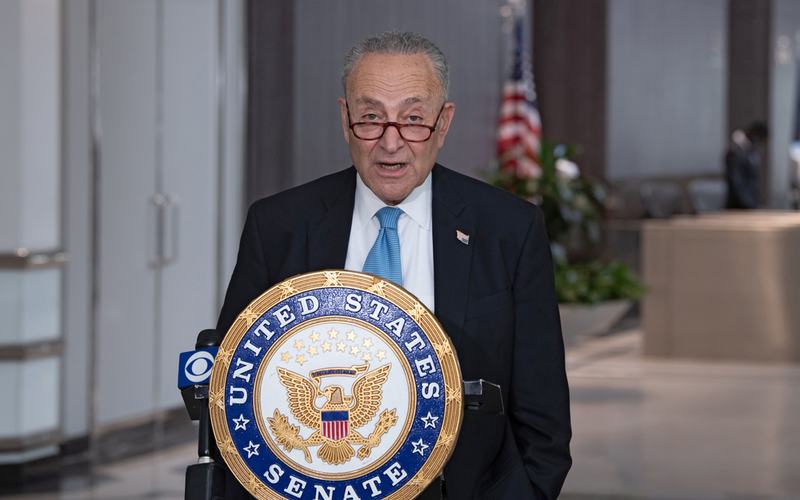
Senate Democratic Leader Chuck Schumer (D-N.Y.) is expected to defeat Sen. Chris Van Hollen (D-Md.) by a substantial margin in the upcoming Democratic leadership election, with allies predicting Schumer will receive more than 40 votes from the party's incoming Senate caucus.
That total would represent more than 70% of a Senate Democratic caucus expected to include at least 55 members next year. The number could rise to 56 if Democratic candidate Mary Peltola wins Alaska's Senate race.
Schumer's allies are also considering an effort to move the leadership election to November, rather than holding it on the currently scheduled date of December 1. Changing the election date would require a separate vote among Senate Democrats. Schumer's supporters want to secure an early victory and shorten the period of public attention surrounding the leadership challenge and divisions within the party.
Van Hollen formally announced his campaign Thursday night and used a speech Friday in Denver at a post-election gathering of Democrats to argue that voters had called for a change in the party's leadership.
"That's why I am running for majority leader of the United States Senate," Van Hollen said.
Schumer's supporters have largely dismissed the challenge, with one confidant telling The Hill that Van Hollen has little chance of winning. A Senate insider close to Schumer described the challenge as a distraction and suggested progressives were using the campaign to pressure party leadership into adopting policy priorities such as Medicare for All and eliminating the Senate filibuster, which requires 60 votes to advance most legislation.
Van Hollen has acknowledged that he faces an uphill battle against the sitting leader. "Let me be clear, I'm the underdog in this race," he said at a Denver press conference. He also argued that the power held by an incumbent leader to negotiate deals and shape the party's agenda is part of the problem he wants to address.
As of Friday, Van Hollen had secured four public commitments: Sens. Bernie Sanders (I-Vt.) and Jeff Merkley (D-Ore.), along with incoming senators Abdul El-Sayed of Michigan and Peggy Flanagan of Minnesota. He declined to disclose how many additional colleagues had privately pledged their support.
Sen. Elissa Slotkin (D-Mich.) has not endorsed Van Hollen but told reporters in Denver that she would not vote for Schumer, adding another potential complication for the incumbent leader.
Van Hollen's allies have interpreted Schumer's push for an earlier election as evidence that his support may not be as secure as his camp claims. A former Senate Democratic chief of staff criticized the effort to change the caucus schedule, describing it as a sign of "panic."
Schumer, meanwhile, has told colleagues that he has secured the votes needed to remain leader. His supporters point to commitments from Democrats across the party's ideological spectrum, including incoming Senate Democratic Whip Brian Schatz (D-Hawaii), who is expected to become the caucus's second-ranking member, as well as Sens. Mark Kelly (D-Ariz.) and Ruben Gallego (D-Ariz.). Incoming Sen. Sherrod Brown of Ohio has also publicly backed Schumer.
Schumer's position as the presumptive leader also gives him influence over coveted Senate committee assignments, a form of leverage that one ally believes could help secure support from uncommitted incoming senators James Talarico of Texas and Chris Pappas of New Hampshire.
The Senate Democratic caucus is scheduled to hold its leadership election by secret ballot on December 1. The outcome will determine who leads Senate Democrats as the party prepares for the next Congress.

Comments
No comments yet. Be the first to share your thoughts.