
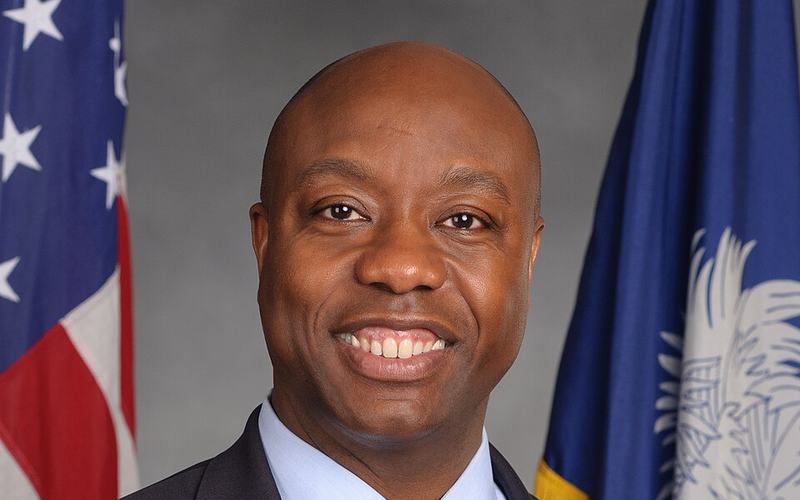
Sen. Tim Scott, Chairman of the National Republican Senatorial Committee, said on Wednesday that Republicans are positioned to retain control of the Senate and could expand their majority, while acknowledging a highly competitive map with numerous races expected to remain close through Election Day.
Speaking to reporters with 34 days remaining before the election, Scott described the 2026 Senate map as unusually competitive, identifying North Carolina, Maine, Iowa, Alaska, Ohio, New Hampshire, Michigan, Minnesota, Texas and Georgia as toss-up contests.
Scott said Republicans intend to coordinate their efforts during the final stretch, with President Donald Trump, Vice President JD Vance, Senate Majority Leader John Thune, Sen. John Barrasso and Scott himself expected to campaign in battleground states. He also pointed to major fundraising efforts by the NRSC, Senate Leadership Fund and MAGA Inc.
Scott said White House Chief of Staff Susie Wiles told him that “money will not be our problem,” while he cited more than $400 million available for Republican efforts. “Cash is king,” Scott said, arguing that the financial resources would give Republicans the ability to communicate their message in competitive races.
He highlighted North Carolina, where Republican Michael Whatley is facing Democrat Roy Cooper, and Maine, where Republican Sen. Susan Collins is defending her seat against Democrat Troy Jackson. Scott said the Maine contest was “closing in our favor” and described Republicans as within striking distance.
In Ohio, Scott said Republican Sen. Jon Husted's race against former Democratic Sen. Sherrod Brown had moved to what he described as a dead-even contest. He also pointed to Iowa, Alaska and New Hampshire as important Republican defensive or pickup opportunities.
Scott described New Hampshire as a potential Republican pickup with former Gov. John Sununu running in the open-seat race. Republicans currently hold only one Senate seat in New England, and Scott said a Sununu victory would double the party's representation in the region.
In Michigan, Scott promoted Republican Mike Rogers' campaign against Democrat Abdulrahman Mohamed El-Sayed, focusing heavily on differences between the candidates over immigration enforcement, policing and other policy issues. He argued that those differences could help Rogers compete in the closely watched race.
Scott also acknowledged that Republicans have work to do in Georgia, where GOP nominee Mike Collins is challenging Democratic Sen. Jon Ossoff. He praised Collins' campaign efforts while describing the race as close.
In Texas, Scott expressed confidence in Republican Ken Paxton's campaign against Democrat James Talarico. He criticized several of Talarico's past statements and argued that the Democratic nominee's views on gender, religion, and capitalism would be out of step with Texas voters.
Scott similarly pointed to Minnesota, where Republican Michele Tafoya is challenging Democrat Peggy Flanagan. He praised Tafoya as a strong recruit and said the race had become highly competitive.
The Nebraska race also came up during the press call, with Scott discussing Republican Sen. Pete Ricketts' contest against independent candidate Dan Osborn. Scott said the race remained tight but argued that Republican enthusiasm and recent polling trends were favorable for Ricketts.
Scott's assessment comes amid competing views about the Senate map. Republicans have publicly emphasized their ability to defend vulnerable seats and potentially gain Democratic-held seats, while outside political analysts have identified numerous Republican seats as competitive. Recent reporting has also shown the NRSC concentrating significant resources on states including Alaska, Iowa, Ohio, Maine, Texas, Michigan and New Hampshire.
Scott also addressed Democratic candidates who have emphasized their Christian faith, including Talarico in Texas and Adam Hamilton in Kansas. He said candidates do not have to share his beliefs to be strong Americans but questioned how Talarico's stated views on religion and gender fit with Christianity.
The NRSC chairman ultimately framed the election as a contest over economic policy, public safety, immigration, government spending, and the direction of the country. While Scott said Republicans are in a position to maintain or expand their majority, the large number of closely contested races leaves control of the Senate dependent on the results across several battleground states.

Comments
No comments yet. Be the first to share your thoughts.