
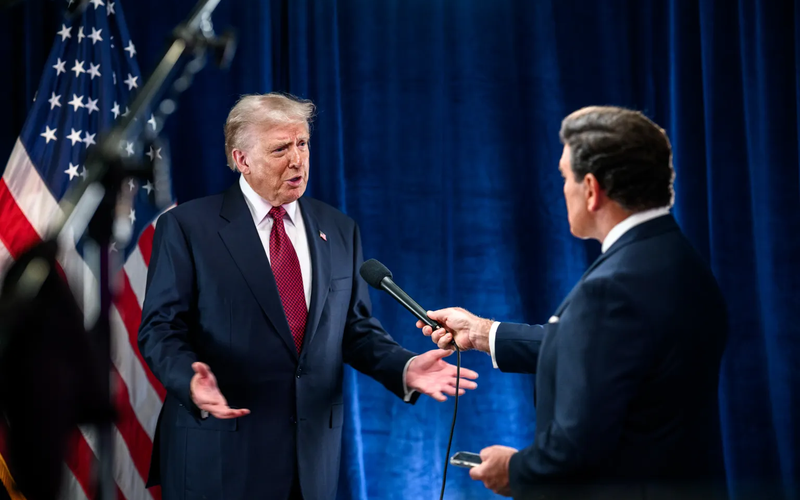
President Donald Trump revealed on Sunday that the United States sent guns to Iranian protesters during widespread anti-regime demonstrations earlier this year, routing the weapons through Kurdish intermediaries.
Fox News chief foreign correspondent Trey Yingst shared details from a phone interview with Trump during an appearance on Fox & Friends Weekend. Trump stated, "We sent them a lot of guns. We sent them through the Kurds." He added that he believes the Kurds kept the weapons, as they largely did not reach the protesters.
The disclosure came amid ongoing U.S.-Iran tensions, including a war that began on February 28, 2026, with Operation Epic Fury airstrikes by the United States and Israel. Negotiations between the two nations continue, led by U.S. envoys Steve Witkoff and Jared Kushner, with Trump expressing optimism for a deal by Monday.
The weapons effort coincided with massive protests that erupted across Iran on December 28, 2025, triggered by a severe cost-of-living crisis, currency collapse, and economic woes exacerbated by U.S. sanctions. The demonstrations persisted into early 2026 and marked some of the largest anti-regime actions in decades. On January 2, 2026, Trump posted on Truth Social, warning that if the regime killed peaceful protesters, "the United States of America will come to their rescue." He later urged, "KEEP PROTESTING – TAKE OVER YOUR INSTITUTIONS," adding that "HELP IS ON ITS WAY."
Trump claimed the Iranian regime killed around 45,000 civilians in the crackdown. Independent estimates vary: Human Rights Activists News Agency reported over 7,000 deaths, while some local Iranian officials suggested more than 30,000.
Several Iranian Kurdish opposition parties denied receiving any weapons from the United States. Hejar Berenji, a representative of the Democratic Party of Iranian Kurdistan (PDKI), stated, "We did not receive any weapons during the time of the demonstrations in Iran." Similar denials came from the Kurdistan Free Life Party (PJAK), Komala Party, Kurdistan Freedom Party (PAK), and others, who said they obtained arms through long-standing conflicts or black markets.
Trump has expressed mixed views on Kurdish involvement in the conflict. In early March, he called it "wonderful" if Iranian Kurds attacked from Iraq, but later ruled it out to avoid complicating the war. On Sunday, he threatened further strikes on Iranian power plants and bridges if Tehran does not open the Strait of Hormuz and reach a deal, specifying Tuesday at 8 p.m. ET as a potential deadline.
The White House and the Iranian foreign ministry did not immediately respond to requests for comment outside business hours.

Comments
No comments yet. Be the first to share your thoughts.