
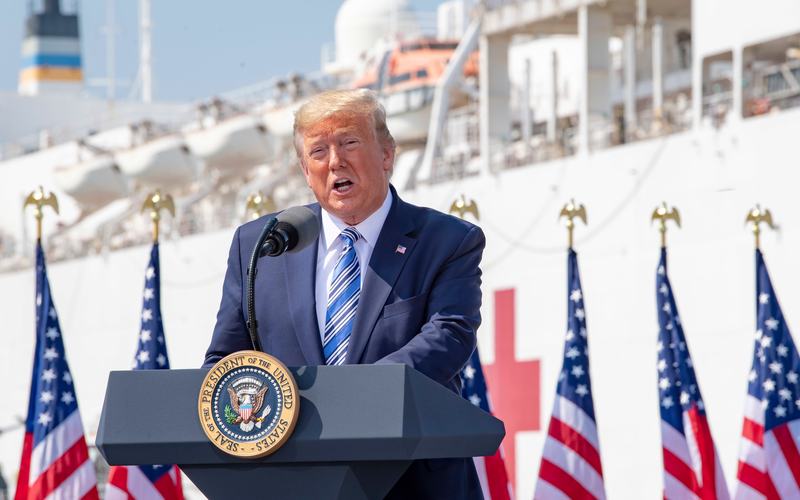
President Donald Trump vowed to bomb Iran "back to the stone ages, where they belong" unless a deal ends the ongoing conflict, escalating rhetoric in the weeks-long war.
In a 19-minute prime-time address from the White House on Wednesday, April 1, Trump claimed U.S. military objectives against Iran were nearing completion after strikes on more than 11,000 targets. He stated the operation had obliterated Iran's nuclear program, ballistic missile sites, and hardline leadership. "Over the next two to three weeks, we're going to bring them back to the stone ages," Trump said, warning of attacks on electric generating plants, "very hard and probably simultaneously," and possibly oil facilities if Tehran refuses terms.
The conflict began on February 28, 2026, when U.S. and Israeli forces launched joint strikes under Operation Epic Fury in response to what Trump called an imminent nuclear threat from Iran. Previous tensions included a 12-day U.S.-Israel-Iran war in June 2025 and Trump's 2018 withdrawal from the 2015 nuclear deal. Iran retaliated by closing the Strait of Hormuz, through which 20% of global oil passes, attacking commercial tankers, Gulf refineries, and launching missiles at Israel.
Trump framed the war as an "investment in your children and your grandchildren's future," arguing it prevents Iran from arming terrorists with nuclear weapons. He noted ongoing discussions for a ceasefire tied to reopening the strait but urged allies to show "delayed courage" in retaking it. The president predicted the strait would "open up naturally" post-war, despite U.S. independence from Middle East oil.
On Friday, escalations continued as Iran downed a U.S. fighter jet over its territory and struck Gulf refineries, prompting a search for the crew. Trump responded on social media: "The U.S. military hasn't even started destroying what's left in Iran. Bridges next, then Electric Power Plants." Iran rejected a U.S. ceasefire proposal and fired missiles at Israel.
Oil prices surged past recent highs, pushing U.S. gasoline above $4 per gallon amid the strait closure's energy crisis. Stock futures fell after the speech due to uncertainty over the timeline, now entering its sixth week.
Reactions split along partisan lines. Republicans praised Trump's resolve, while critics, including former Rep. Marjorie Taylor Greene, questioned the strategy. International voices, like Australian Prime Minister Anthony Albanese, expressed concern over undefined end goals. Legal experts warned that infrastructure strikes could violate the Geneva Conventions by targeting civilian objects.
Trump was attended by top officials, including Vice President JD Vance and Secretary of War Pete Hegseth, who echoed the hardline stance. As day 35 approaches, the U.S. maintains air superiority without ground troops, focusing on precision strikes to pressure Iran's regime.

Comments
No comments yet. Be the first to share your thoughts.