
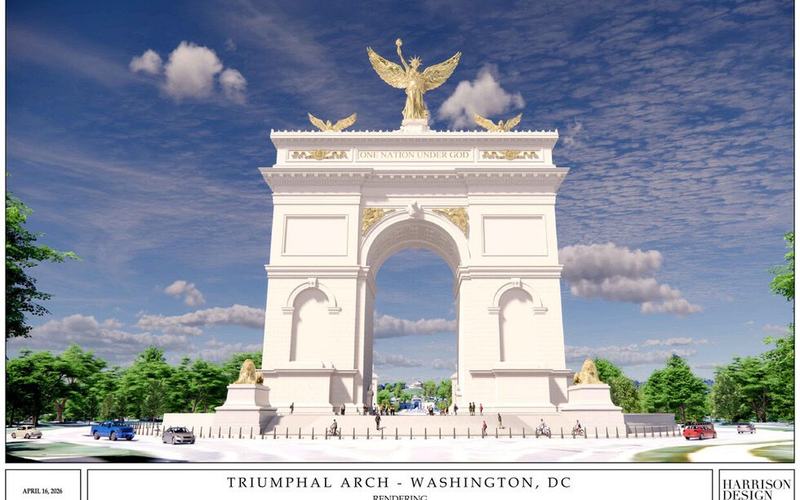
The Arlington County Board in Virginia filed a federal lawsuit Thursday seeking to halt construction of President Donald Trump’s planned Triumphal Arch, becoming the first governmental body to take legal action against the proposed monument near Arlington National Cemetery and Memorial Circle.
Filed in the U.S. District Court for the Eastern District of Virginia, the lawsuit argues that the National Park Service is moving too quickly toward construction without completing the required environmental review process. The county is asking the court to stop further progress until federal officials comply with the National Environmental Policy Act and conduct the necessary analysis.
The proposed 250-foot arch has become a point of dispute over the administration’s plans to reshape Washington’s monumental landscape. County officials argue that the project could have significant consequences for nearby communities and contend that federal agencies have not adequately addressed their concerns.
In its filing, the county accused the National Park Service of advancing the project despite publicly maintaining that a final construction decision had not been made. The lawsuit argues that the agency’s accelerated process appears intended to justify a project President Trump has repeatedly directed officials to pursue.
Arlington County Board Chair Matt de Ferranti said the county brought the lawsuit because local residents stand to be directly affected by the proposed construction. He said county officials had participated in the review process in good faith but believed their concerns about the project’s potentially severe and wide-ranging effects had been disregarded.
The county is represented by Democracy Forward, a legal advocacy organization. The White House and the Interior Department had not immediately responded to requests for comment at the time of the original report.
The lawsuit follows separate concerns raised by aviation and labor representatives about the monument’s proposed location and potential security features. Sara Nelson, president of the Association of Flight Attendants-CWA, warned that the arch could compound existing aviation safety concerns following the January 2025 midair collision over the Potomac River that killed 67 people.
Nelson also criticized proposals to incorporate military-style security capabilities into the structure, including drones and sniper positions, along with ammunition storage. Those concerns have added another dimension to the debate over the project’s design and location.
The Arlington County lawsuit is not the only legal challenge facing the monument. A separate group consisting of three veterans and an architectural historian filed suit in federal court in Washington, D.C., arguing that congressional approval is required before the project can proceed.
The arch has received preliminary approval from the U.S. Commission of Fine Arts, whose members were appointed by Trump. However, that approval has not resolved the legal questions raised by opponents regarding the project's authorization and review requirements.
The proposed monument is part of a broader effort by Trump to alter Washington’s appearance through high-profile construction and renovation projects. Other initiatives have included work involving a historic public golf course and plans affecting the John F. Kennedy Center for the Performing Arts.
The legal challenges now threaten to complicate the administration’s timetable for the arch, as courts consider whether federal agencies have followed the procedures required to move the project forward.

Comments
No comments yet. Be the first to share your thoughts.