
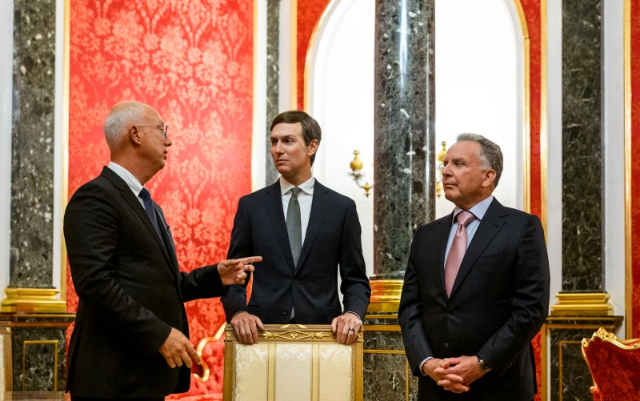
President Donald Trump's special envoy Steve Witkoff and Jared Kushner are scheduled to meet separately with Russian President Vladimir Putin and Ukrainian President Volodymyr Zelenskyy on Thursday as Washington seeks to build on recent negotiations aimed at ending the war in Ukraine.
Witkoff and Kushner will travel to Moscow first to meet Putin before heading to Dublin, where they plan to brief Zelenskyy during his meetings with European leaders. Kushner said the discussions would focus on reviewing proposals raised during two days of U.S.-brokered talks in Abu Dhabi and identifying opportunities for further progress.
The negotiations produced an agreement in principle between Russia and Ukraine for what Kushner described as the largest prisoner exchange of the war. Officials did not disclose how many prisoners would be involved.
Ukraine's chief negotiator, Rustem Umerov, said the discussions had made progress but acknowledged that significant disagreements remained. Russian delegation chief Vladimir Medinsky also indicated that negotiations would continue, although he questioned the need for European participation.
Moscow has resisted expanding the talks to include European governments, with Medinsky arguing that European countries had not presented concrete peace proposals. Ukraine, meanwhile, wants its principal European supporters involved in negotiations over the country's future security.
Kushner said bringing European representatives into the negotiating framework would be among the subjects discussed with Putin. He also urged European governments to select a single representative to speak on their behalf.
Officials from Britain, France, Germany and Italy, along with representatives of NATO and the European Union, traveled to Abu Dhabi for meetings alongside the main negotiations. The United States, Ukraine, European governments and NATO later reaffirmed their shared commitment to establishing a strong European security arrangement after the war.
The dispute over Europe's role reflects broader disagreements about the terms of a potential settlement. Russia is demanding that Ukraine withdraw from parts of the eastern Donbas region still under Kyiv's control and is seeking a broader agreement addressing Europe's security structure. Moscow's demands include limiting NATO's military presence in Eastern Europe and ending Western military support for Ukraine.
Ukraine has rejected making territorial concessions before a ceasefire and has called for a direct meeting between Zelenskyy and Putin to address the most difficult issues. No such meeting has been arranged. Russia has invited Zelenskyy to Moscow, while Putin has resisted meeting him on neutral ground.
Kushner described the Abu Dhabi negotiations as a productive first step, saying the sides had identified some areas where compromises might be possible while acknowledging that other issues would require additional discussions. He also said the United States wants to establish a new security framework involving Ukraine, Russia and Europe that could provide lasting stability.
European governments have expressed concern that negotiations led by Washington and Moscow could produce an agreement that favors Russia or determines Europe's security arrangements without sufficient European input. Germany said Wednesday that Russia must first end the war before discussions on the continent's future security structure can proceed.
The war began with Russia's full-scale invasion of Ukraine in February 2022 and has become Europe's deadliest conflict since World War II, killing hundreds of thousands and forcing millions from their homes. Large areas of eastern and southern Ukraine have suffered extensive destruction from fighting and Russian bombardments.
Trump suggested before the latest negotiations that Ukraine could ultimately lose territory under a settlement, saying the country would emerge in a “little bit different shape.” Zelenskyy has continued to insist that any agreement must address Ukraine's sovereignty and security rather than impose territorial concessions before hostilities end.

Comments
No comments yet. Be the first to share your thoughts.