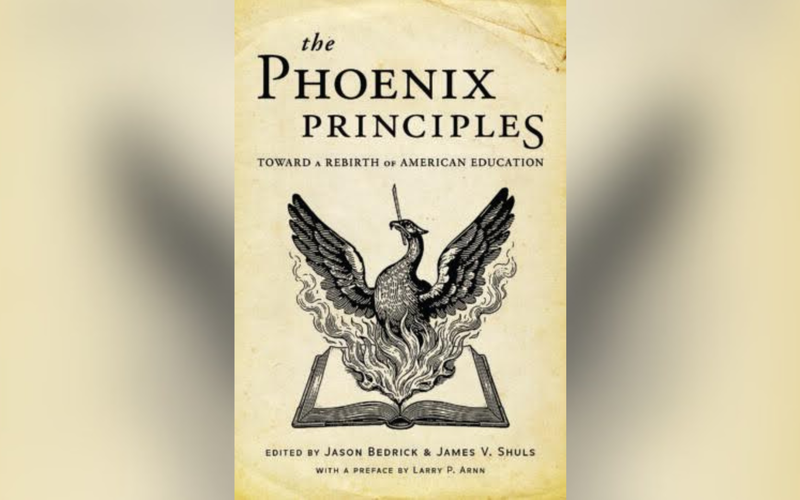
The Phoenix Principles: Toward a Rebirth of American Education, edited by Jason Bedrick and James V. Shuls (Encounter Books, 2026), offers a constructive and coherent vision for what American education could and should be.
Named for the mythical bird that rises renewed from its own ashes, the volume gathers essays from leading thinkers and practitioners in education policy. The chapters are organized to mirror the sections of the Phoenix Declaration, a statement of principles released by The Heritage Foundation and a coalition of scholars and organizations (available at heritage.org). That declaration and this book arrive at a moment when critiques of the status quo are abundant. Pointing out the faults and shortcomings of a system one opposes can be both necessary and clarifying. Yet when that system educates roughly four-fifths of the nation’s school-age children, criticism alone is insufficient. A serious alternative requires a positive statement of purpose, content, and practice. Bedrick and Shuls, with their contributors, supply one.
The book articulates seven foundational principles: parental choice and responsibility; transparency and accountability; truth and goodness; cultural transmission; character formation; academic excellence; and citizenship. Together they form a roadmap for restoring coherence to K–12 education—not as a preparation for the workforce alone, but as formation for life in a free society. Education, the editors remind us (echoing G.K. Chesterton), is the “soul of a society as it passes from one generation to another.” That transmission is neither automatic nor guaranteed. It requires deliberate effort to pass on knowledge, virtues, and civic ideals.
The editors have chosen contributors who write with clarity and persuasiveness on their respective topics. One strong example is the chapter on character formation by Dr. Matthew Mehan of Hillsdale College. Through historical examples, Mehan shows that the cultivation of morality and virtue was long understood as a primary aim of education, not a secondary or optional concern. Schools were expected to help form young people capable of self-government, personal responsibility, and disciplined judgment. In an era often focused on skills, credentials, and competing ideological claims, Mehan’s recovery of this older priority is both timely and bracing. Character is not a soft add-on to academics; it is part of what makes academic excellence and civic competence possible.
Other chapters develop the remaining principles with similar seriousness. Parental choice is presented not as a market slogan but as recognition that parents are the primary educators of their children and that education funding should follow the child. Transparency and accountability emphasize openness with families about curriculum, policy, and student well-being. Truth and goodness insist that education be grounded in objective reality rather than shifting ideological fads and fashions. Cultural transmission calls for passing on the accumulated knowledge of Western and American traditions, including the nation’s founding documents and the full record of its achievements and failures. Academic excellence prioritizes rigorous, content-rich instruction in foundational subjects. Citizenship aims at the knowledge and habits necessary for self-government in a constitutional republic.
The result is not a detailed legislative blueprint or a catalog of grievances. It is a set of first principles that can orient parents, teachers, school leaders, and policymakers. In a polarized environment, the book’s insistence on shared goods—truth, virtue, excellence, and ordered liberty—offers common ground that transcends narrow partisanship. It treats education as a formative enterprise rather than a site of political combat or mere economic preparation.
As the nation marks its 250th anniversary, questions about the purpose of schooling have grown more urgent. Declining academic performance, eroding trust, and competing visions of what children should learn have left many families and communities searching for direction. The Phoenix Principles does not claim to solve every practical problem. It does something more foundational: it recalls what education is for and invites readers to rebuild accordingly. Policymakers, educators, and citizens concerned with the long-term health of American self-government will find it a clarifying and encouraging contribution.

Comments
No comments yet. Be the first to share your thoughts.