
Late Thursday, U.S. District Judge Indira Talwani ruled that the regulation is likely unlawful because it inserts the federal government into election administration without explicit congressional authorization. The order halted implementation for at least 14 days in cases brought by the League of Women Voters and a coalition of states.
While the 14-day restraining order is active, Judge Talwani may decide whether to issue a longer-lasting block on USPS' plan after holding a Sept. 3 hearing.
This order has come off a recent favorable ruling by the Supreme Court, which said President Donald Trump can now advance his administration's plan to implement an election-integrity order, including new mail-ballot standards and efforts involving state citizenship lists.
Having ruled multiple times in cases related to Trump's order, Judge Talwani has re-established a nationwide block she had imposed on USPS' efforts to carry out the order.
The Supreme Court weighed in on a similar ruling Judge Talwani made in June, saying she had acted too early, before USPS issued a final plan to carry out Trump's directives.
In response to the Supreme Court's procedural ruling, Judge Talwani lifted her prior nationwide injunction temporarily blocking the Postal Service from implementing certain mail-in voting safeguards. She explained that the Supreme Court’s order “compelled” her to modify the injunction.
By doing so, Talwani can continue to oversee ongoing litigation without contradicting the high court’s authority.
Judge Talwani’s order could soon be appealed back to the Supreme Court, placing the proverbial ball in their court in this legal back-and-forth.
What is the Executive Order?
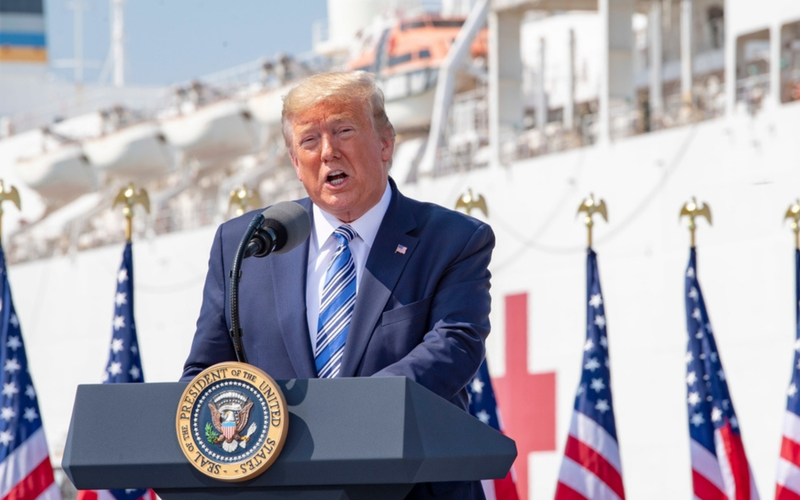
The executive order issued in March stemmed from Trump's desire to direct the Postal Service to establish uniform standards for federal mail-in and absentee ballots. The order required states to submit lists of eligible voters to the USPS and mandated that ballot envelopes bear unique barcodes for tracking.
Besides USPS, Trump’s order directs the Department of Homeland Security to compile and provide states with lists of adult U.S. citizens, while the Department of Justice was told to prioritize investigations and potential prosecutions involving ballots issued to ineligible voters.
Earlier this week, the Postal Service finalized its plan for the November election, focusing largely on state ballot design and barcode-tracking requirements, opting to ignore or water down the more controversial aspects of the executive order.
Currently, states are not being asked to provide the USPS with detailed voter eligibility lists that include personally identifiable information, such as citizenship. The USPS also says outright that it "will not play any role in determining voter eligibility, maintaining voter rolls, or counting ballots."
However, the Postal Service will soon direct states to ensure their mail ballots comply with certain design standards, including the use of barcodes and the requirement that voters verify their addresses prior to delivery.
Road of Controversies
Democrats and voting rights groups contend the Postal Service’s demand is unconstitutional, citing the Constitution and saying states are granted, and, in some cases, Congress the power to make election rules—not the president or the Postal Service.
Critics cited fears that elections will no longer be held in the hands of the states, saying the government will control elections moving forward.
Constitutional concerns have arisen regarding the executive order, which is said to break with the long-standing norm that states run their own elections, as established by Article I, Section 4 of our Constitution.
This shift also raises security concerns, as experts widely agree that the decentralized nature of U.S. elections makes them more resilient to foreign and domestic interference.
According to States United, nearly one in three Americans voted by mail in 2024, among those including President Trump.
State officials have led the charge against the executive order, accusing the Trump Administration of purposely making voting harder for Americans.
The Supreme Court weighed in on the broader legal challenges Monday. In a 6-3 decision, the justices lifted a prior injunction against portions of the executive order, finding that claims by 23 states and the District of Columbia were premature because the government had not yet finalized its plans.
The Trump Administration says the executive order will ensure that voter corruption ends by strengthening enforcement to reduce fraud and maintain fair and honest elections.
Trump has long criticized mail-in voting, which he falsely attributes to his 2020 election loss to former President Joe Biden.
According to a 2025 report by the Brookings Institution, mail-in voting fraud was recorded in only about four cases per 10 million mail ballots cast, contradicting claims by Trump and his allies that election fraud is widespread.
While the Trump Administration celebrates this advancement of the executive order, smaller disputes are expected, producing another round of litigation as agencies make their next moves.
California Attorney General Rob Bonta, Pennsylvania Gov. Josh Shapiro, and Arizona Attorney General Kris Mayes have publicly criticized the Thursday ruling, promising to continue challenging the executive order in smaller courts.
“Not so fast,” Gov. Shapiro said in an X post. “Today’s SCOTUS decision does NOT deal with the substance of Trump’s unconstitutional Executive Order and does not mean his illegal attempt to restrict mail-in voting will go forward.”
The clock is ticking for the November election, as early mail-in ballots will begin arriving, and most states will begin receiving them as early as Sept. 18.
With Judge Talwani’s restraining order in effect, challengers of the executive order are now asking other district judges to follow suit and issue new rulings blocking USPS from carrying out its finalized plan, a move likely to be appealed to the Supreme Court.

Comments
No comments yet. Be the first to share your thoughts.