
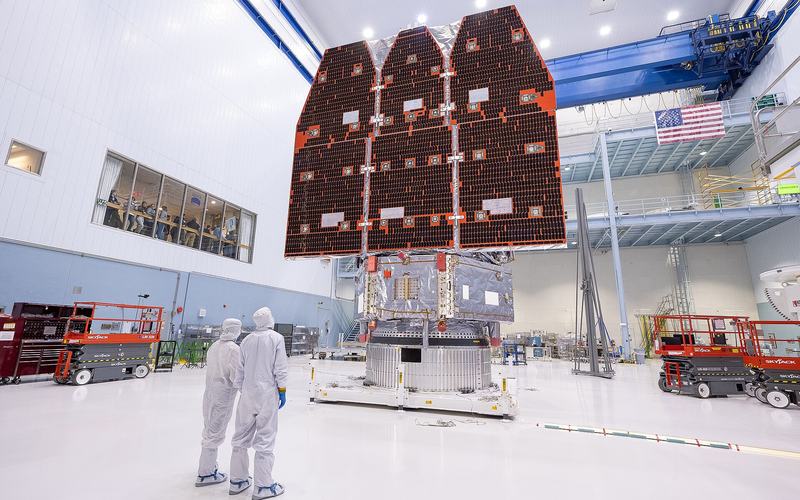
NASA teams conducted the final launch readiness review Friday for the Nancy Grace Roman Space Telescope ahead of a targeted liftoff Sunday morning.
The observatory is set to launch no earlier than 7:26 a.m. EDT on Aug. 30 aboard a SpaceX Falcon Heavy rocket from Launch Complex 39A at Kennedy Space Center in Florida. A backup opportunity exists Monday at 7:22 a.m. EDT.
The mission arrives nine months ahead of its original May 2027 target date. NASA officials have credited efficient planning and adherence to cost controls for the accelerated timeline.
The Nancy Grace Roman Space Telescope, named for NASA's first chief astronomer, will operate at the Sun-Earth L2 Lagrange point roughly one million miles from Earth. It features a wide field of view at least 100 times larger than the Hubble Space Telescope, enabling rapid surveys of the sky in visible and near-infrared light.
Primary science goals include investigating dark energy and dark matter, discovering thousands of exoplanets, and advancing astrophysics research. The spacecraft carries a coronagraph instrument for direct imaging of exoplanets.
Technicians encapsulated the telescope in its payload fairing earlier this month and fueled it with approximately 290 gallons of hydrazine propellant in late July. The spacecraft arrived at Kennedy Space Center in June for final processing.
Launch coverage begins at 6:20 a.m. EDT Sunday, with live streams available on NASA platforms. Post-launch activities include separation from the rocket, transit to L2, and a multi-month commissioning period before science operations begin.
First images from the telescope are expected in early 2027. The mission has a five-year primary lifetime with potential for extension to 10 years.
SpaceX will provide the Falcon Heavy launch vehicle, marking another collaboration between the agency and the private company on flagship science missions.

Comments
No comments yet. Be the first to share your thoughts.