
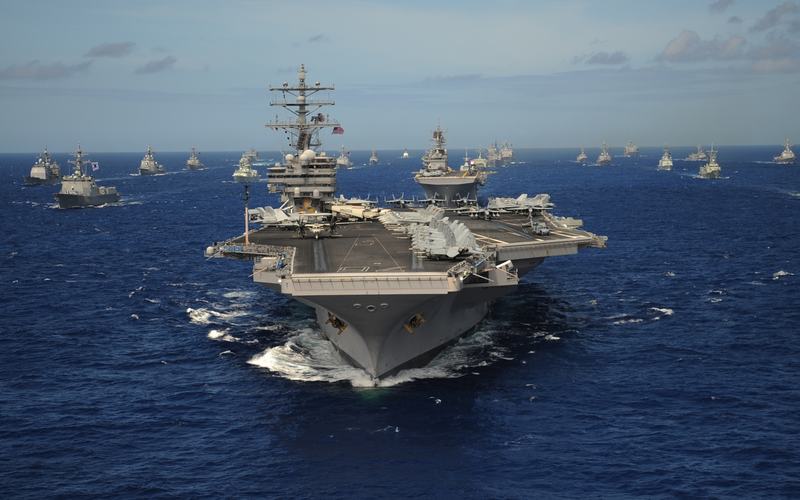
The U.S. Navy seized an Iranian-flagged cargo ship on Sunday after it attempted to breach a naval blockade near the Strait of Hormuz, escalating tensions in the ongoing conflict with Iran.
The guided-missile destroyer USS Spruance intercepted the M/V Touska in the Gulf of Oman, issuing warnings for six hours as the vessel, nearly 900 feet long, sped toward Iran's Bandar Abbas port at 17 knots. When the Iranian crew refused to comply, the destroyer fired several rounds from its 5-inch MK 45 gun into the engine room, disabling propulsion. U.S. Marines from the 31st Marine Expeditionary Unit then boarded and took full custody of the sanctioned vessel, which U.S. Central Command described as a deliberate and proportional enforcement action.
President Donald Trump announced the seizure on X, stating, "The U.S. Navy guided-missile destroyer USS Spruance intercepted the TOUSKA in the Gulf of Oman, and gave them fair warning to stop. The Iranian crew refused to listen, so our Navy ship stopped them right in their tracks by blowing a hole in the engine room. Right now, U.S. Marines have custody of the vessel." He noted the ship's prior U.S. Treasury sanctions for illegal activity and warned Iran of further strikes on infrastructure if it rejects a U.S. peace proposal.
This marks the first forcible boarding since the U.S. imposed its naval blockade on Iranian ports on April 13, amid the eighth week of war that began February 28 with U.S. and Israeli airstrikes on Iranian nuclear sites and military targets. U.S. forces have since redirected 25 vessels back to Iranian waters without incident.
Iran responded sharply, with its joint military command labeling the action piracy and a ceasefire violation. Tehran has vowed a swift response and indicated it may skip planned talks in Islamabad, Pakistan, set for Monday with U.S. envoys, including Vice President JD Vance. Iranian state media cited U.S. "bullying" as undermining diplomacy. The fragile ceasefire, effective since April 8, faces expiration this week.
The Strait of Hormuz, vital for 20% of global oil trade, remains a flashpoint. Iran closed it after the U.S. blockade, briefly reopened it on April 17 during an Israel-Hezbollah truce, then reimposed restrictions Saturday, firing on vessels including Indian-flagged tankers. Hundreds of ships wait at either end, trapping over 20,000 seafarers. No casualties were reported in the Touska incident.
Oil prices surged, with Brent crude rising over 6% to $96 per barrel and West Texas Intermediate to $88, reflecting fears of prolonged disruption. U.S. gasoline averages $4.05 per gallon, up 36% from prewar levels. The blockade aims to squeeze Iran's economy, costing it an estimated $500 million daily, while U.S. officials emphasize freedom of navigation for non-Iranian traffic.
The crisis stems from failed nuclear talks and Iran's support for proxies like Hezbollah. Over 3,500 have died in Iran, with thousands more across the region. As U.S. negotiators prepare for Pakistan despite uncertainties, the Touska seizure underscores the high stakes in enforcing the blockade and pushing for a deal.

Comments
No comments yet. Be the first to share your thoughts.